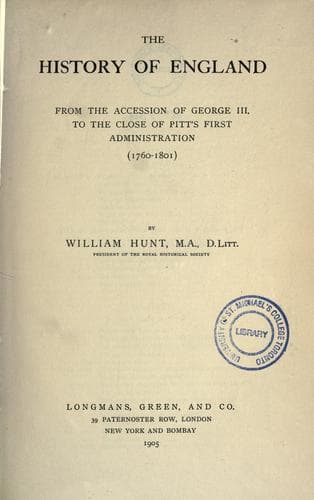
The history of England, from the accession of George III. to the close of Pitt's first administration, 1760-1801Hunt, William
History
The history of England, from the accession of George III. to the close of Pitt's first administration, 1760-1801
Hunt, William
Great Britain -- History -- George III, 1760-1820
The treaty did not protect the loyalists. Shelburne did his best for
them, but Franklin was bitter against them, and his feelings were those
of the victorious party generally. The American commissioners would only
agree that there should be no further confiscations and prosecutions,
and that congress should recommend the several states to revise their
laws concerning them. These articles were nugatory. Nothing short of a
renewal of the war could have induced the Americans to forego their
revenge, and if the war had gone on longer, the loyalists' fate would
have been no better. Everywhere, with the exception of South Carolina,
they were treated with barbarity. Some 60,000 persons left the country
before Carleton evacuated New York, taking refuge either in Great
Britain or her colonies. At least 25,000 of both sexes settled in the
British maritime provinces of North America, and helped to establish the
province of New Brunswick which received representative institutions in
1784; 10,000 others, United Empire Loyalists as they were afterwards
called, in the valley of the St. Lawrence. England did what she could
for her unfortunate friends; liberal grants of land were made to them,
some had half-pay as military officers, and between 1783 and 1790
L3,112,455 was distributed among them, besides L25,785 granted in
pensions.[172] Relief, however, was slow in coming, and many, reduced
from wealth to penury, died in the utmost distress.
[Sidenote: _THE TREATY OF VERSAILLES._]
Preliminaries of peace with France and Spain were signed on January 20,
1783, and were followed by the definitive treaty of Versailles concluded
on September 3. The war brought France into financial difficulties, and
for that reason England, though forced to cede some of her conquests in
the last war, obtained as good terms as she had a right to expect. In
the West Indies she restored St. Lucia to France, ceded Tobago, and
received back Dominica, Grenada, St. Vincent, St. Kitts, Nevis, and
Montserrat. In Africa Senegal and Goree went to France, and Gambia and
Fort St. James were guaranteed to England. France received back her
commercial establishments in India; her right to participate in the
Newfoundland fishery was clearly defined; England ceded to her the
islands of Miquelon and St. Pierre in sovereignty, and the old
stipulation for the demolition of the fortifications of Dunkirk was
given up. France and Spain pressed the government to agree to some
exchange for Gibraltar. The king, Shelburne, and the majority of the
cabinet would have let it go if a sufficient compensation had been
offered; Richmond and Keppel objected to its cession on any terms. The
signature of the American preliminaries strengthened the position of
Great Britain and the question was dropped.[173] Spain retained Minorca
and West Florida, and England ceded East Florida to her. On the other
hand, Spain restored by treaty Providence and the Bahama isles, which
Public-domain text, read in full here on John Shaqi.
Reviews
Reviews
No reviews yet
Be the first to share your thoughts on this work.
Elsewhere in the archive
Join the Discussion
Join the discussion
Sign in to leave a comment or review.
Sign InorCreate an account