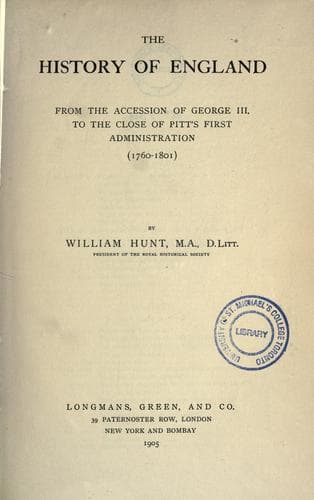
The history of England, from the accession of George III. to the close of Pitt's first administration, 1760-1801Hunt, William
History
The history of England, from the accession of George III. to the close of Pitt's first administration, 1760-1801
Hunt, William
Great Britain -- History -- George III, 1760-1820
The coalition was triumphant. It was condemned by the public, and the
verdict has been endorsed by posterity. Though it is true that North
carried on the war with America only to please the king, that was not
then known, and his conduct in that, and almost every important matter,
was utterly opposed to the principles which Fox professed. What ground
was there for mutual confidence? For eight years Fox had reviled North
with extraordinary bitterness. If his words were just he had no business
to ally himself with him. "My friendships," he said, with a Latin
quotation, "are perpetual, my enmities are not so," a good reason for
reconciliation with a private enemy; but political quarrels should be
founded on differences of principle. Fox's words illustrate his
adherence to the whig notion that the politics of the nation might be
treated by the members of a few great families as their personal
concerns. Of the two, North was at first more blamed than Fox, for it
seemed pusillanimous in him to forgive Fox's treatment, but neither
escaped censure. The king was furious. He had no love for Shelburne, but
he hated Fox, and determined if possible to avoid falling into the hands
of the coalition. He offered the treasury to Pitt, who with admirable
discernment saw that his time was not yet come, and refused it. He tried
Gower; he tried to detach North from the coalition; he even offered
terms to the coalition; then again he pressed Pitt to take the treasury,
and failing in all these attempts, sought help from Chatham's nephew,
Thomas Pitt, and failed to obtain it. From February 24 to April 2 the
country was without an organised government. George was almost in
despair, talked of retiring to Hanover, and spoke bitterly of the
ingratitude of North, whose past subservience to him had been largely
rewarded. At last he was forced to accept the coalition ministry, to
give Portland the treasury, and to submit to the exclusion of Thurlow,
who had been chancellor since 1778 in the ministries of North,
Rockingham, and Shelburne.
Public-domain text, read in full here on John Shaqi.
Reviews
Reviews
No reviews yet
Be the first to share your thoughts on this work.
Elsewhere in the archive
Join the Discussion
Join the discussion
Sign in to leave a comment or review.
Sign InorCreate an account