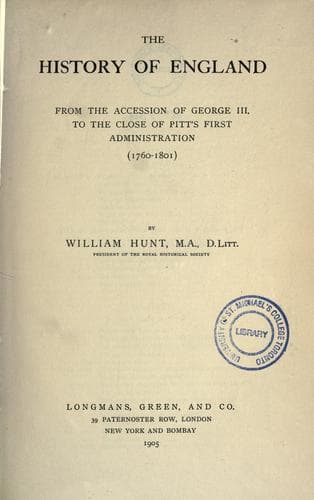
The history of England, from the accession of George III. to the close of Pitt's first administration, 1760-1801Hunt, William
History
The history of England, from the accession of George III. to the close of Pitt's first administration, 1760-1801
Hunt, William
Great Britain -- History -- George III, 1760-1820
The new cabinet consisted of Portland, who was little more than a
figure-head; North and Fox, secretaries of state; Stormont, president of
the council; Carlisle, privy seal; Lord John Cavendish, chancellor of
the exchequer; and Keppel, first lord of the admiralty. All except
Stormont belonged to the party of Fox, the dominant partner in the
coalition. The great seal was placed in commission. Burke again became
paymaster, and Sheridan was secretary to the treasury. George was
determined not to give his confidence to the ministers who had thus
thrust themselves upon him, and to get rid of them as soon as possible.
Fox applied himself assiduously to the duties of office, as indeed he
did during the Rockingham administration, and strove in vain to overcome
the king's dislike by deferential behaviour. George's hostility was
strengthened by the friendship between Fox and the Prince of Wales. The
prince's habits were dissolute and extravagant; he was an undutiful son,
and the king a somewhat unforgiving father. He violently espoused the
cause of the coalition, and George is said to have called the government
"my son's ministry". It was time to provide him with a separate
establishment, and Fox promised him that he would ask parliament for
L100,000 a year. The majority of the cabinet thought the sum too large.
The king was of the same opinion, and did not wish his son to be
independent of all parental control. He therefore offered him an
allowance of L50,000 from the civil list. Fox was unwilling to
disappoint the prince, and the dismissal of the ministers seemed
certain. They were saved by the prince's acceptance of the king's offer,
in addition to the revenues of the duchy of Cornwall which amounted to
L12,000 a year; and parliament had only to vote him L60,000 for his
debts and present expenses. The question of parliamentary reform was
again brought forward by Pitt. As before, he urged that reform would
prevent the crown from again exercising corrupt influence in parliament.
He proposed as resolutions that the number of county and metropolitan
members should be increased, suggesting an increase of at least a
hundred, and that for the future any borough which was found by a
committee of the house to be grossly corrupt should be disfranchised.
This, he believed, would gradually reduce the number of members to what
it then was, and would purify elections. North opposed the motion, Fox
spoke in favour of it, though he wished that it had gone further. It was
lost by 293 to 149. The public was no longer so eager for reform as in
1780.[174] Sawbridge's annual motion for shortening the duration of
parliament was lost by 121 to 56.
[Sidenote: _WARREN HASTINGS IN INDIA._]
Public-domain text, read in full here on John Shaqi.
Reviews
Reviews
No reviews yet
Be the first to share your thoughts on this work.
Elsewhere in the archive