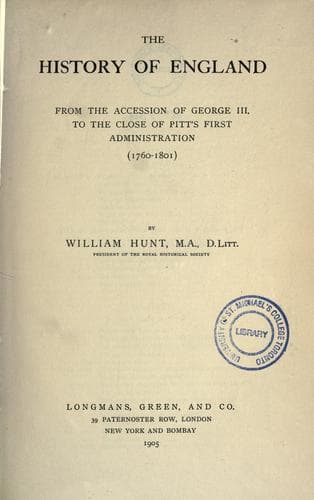
The history of England, from the accession of George III. to the close of Pitt's first administration, 1760-1801Hunt, William
History
The history of England, from the accession of George III. to the close of Pitt's first administration, 1760-1801
Hunt, William
Great Britain -- History -- George III, 1760-1820
Indian affairs demanded immediate legislation. The company's charter was
renewed in 1781; a new arrangement was made as to its dividends and its
payments to the state, and its political transactions were placed more
completely under ministerial control. Two committees were also appointed
by the house of commons to inquire into its administration. Of one of
these Burke was the most active member, and Dundas, then holding office
under North, was chairman of the other. In 1782 Dundas moved resolutions
condemning the company's administration; the Rockingham ministry took
the matter up, and the house voted that Warren Hastings, the
governor-general, should be recalled. The directors agreed, but on
Rockingham's death the proprietors refused their assent. North's
regulating act of 1773 worked badly. From 1774 to 1780 Hastings was
thwarted in council by three of the four councillors sent out by the
ministers, and specially by Francis, the reputed author of the Junius
letters, who opposed him with extreme rancour. Hastings fought a duel
with him in 1779 and wounded him; he returned to England, and Hastings
gained a majority in the council. The Madras council also quarrelled
with their governor, Lord Pigot; he was arrested by their order and died
in confinement. Other difficulties arose from the independent action of
the minor governments of Bombay and Madras, and from the indefinite
character of the powers of the supreme court of judicature.
Administrative abuses existed, and the extreme financial difficulties
caused by the wars with the Marathas, Haidar Ali, and the French, drove
Hastings to adopt some high-handed measures. The Rockingham whigs were
adverse to him, and Burke, whose generous emotions were roused by any
tale of oppression, applied himself to collecting evidence against him,
which his fervid imagination magnified and distorted.
Public-domain text, read in full here on John Shaqi.
Reviews
Reviews
No reviews yet
Be the first to share your thoughts on this work.
Elsewhere in the archive
Join the Discussion
Join the discussion
Sign in to leave a comment or review.
Sign InorCreate an account