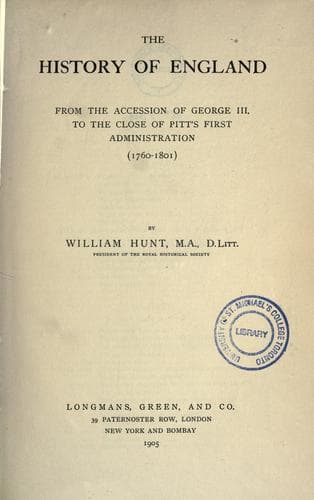
The history of England, from the accession of George III. to the close of Pitt's first administration, 1760-1801Hunt, William
History
The history of England, from the accession of George III. to the close of Pitt's first administration, 1760-1801
Hunt, William
Great Britain -- History -- George III, 1760-1820
The refusal of the proprietors to recall Hastings was highly displeasing
to the commons, and a petition from the company for relief from some
obligations imposed in 1781 gave occasion to parliament again to
interfere in its affairs. In April, 1783, Dundas, who was then in
opposition to the coalition ministry, proposed a bill for the government
of India. His plan was to render the governor-general more independent
of his council, to subordinate more completely the inferior governments
to the government of Bengal, to change the uncertain tenure of the
zamindars into hereditary possession, to recall Hastings, and to appoint
some noble, like Cornwallis, as his successor. As the government
promised to bring in an India bill the next session, he allowed his bill
to drop. When parliament reassembled in November, Fox brought in two
bills, which were largely prepared by Burke, one affecting the
constitution of the company, the other its administration in India. The
first vested the management of the territories, revenue, and commerce
of the company in seven commissioners, named in the bill, for four
years, with power to appoint and remove all officers of the company.
After that term Fox suggested that the crown should nominate the
commissioners, and meanwhile was to appoint to vacancies. Commercial
transactions were to be managed by a subordinate board chosen by
parliament from among the larger proprietors. The second bill abolished
all monopolies in India, prohibited the acceptance of presents, and gave
native landlords an hereditary estate. The objections urged against the
first bill by the opposition, and chiefly by Pitt, Grenville, and
Dundas, were grounded on its violation of the company's charter, and its
tendency to vest the patronage of India in the existing ministry. Fox
ably defended the bill, and Burke, in an eloquent speech, depicted, with
much exaggeration, the injustice which, he maintained, the millions of
India had suffered during Hastings's administration, and argued that the
delinquencies of the company justified the violation of its charter.
Public-domain text, read in full here on John Shaqi.
Reviews
Reviews
No reviews yet
Be the first to share your thoughts on this work.
Elsewhere in the archive
Join the Discussion
Join the discussion
Sign in to leave a comment or review.
Sign InorCreate an account