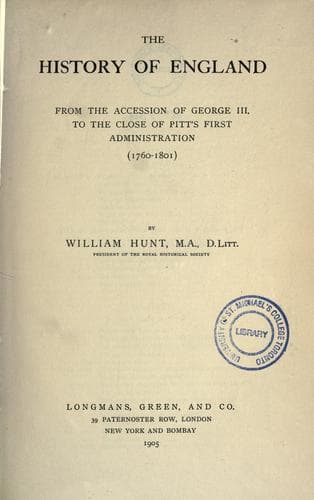
The history of England, from the accession of George III. to the close of Pitt's first administration, 1760-1801Hunt, William
History
The history of England, from the accession of George III. to the close of Pitt's first administration, 1760-1801
Hunt, William
Great Britain -- History -- George III, 1760-1820
It was, however, the political side of the bill which chiefly roused
opposition. All seven commissioners belonged to Fox's party. For four
years it vested in his nominees "all the patronage of the East". Pitt
declared that it created "a new and enormous influence"; Grenville that
"the treasures of India like a flood would sweep away our liberties".
Fox was accused of making himself "King of Bengal," and a caricature
represents him as Carlo Khan entering Leadenhall street on an elephant
which has the face of North and is led by Burke. All this was party
exaggeration; the bill was a genuine attempt to benefit the natives of
India, and would not probably have had any really serious consequences
in England, though the control of the Indian patronage for four years
would have strengthened Fox's party, and, if it had afterwards been
vested in the crown, would have given some opportunity for the exercise
of corrupt influence by ministers. The king was waiting for an
opportunity to get rid of the coalition ministry, and Thurlow and Temple
easily excited his jealousy for the prerogative by telling him that the
bill would deprive him of half his power and disable him for the rest of
his life. His influence in the commons was diminished by recent
legislation, and there the bill was carried by two to one. Before the
second reading in the lords he gave Temple a card authorising him to
say that, whoever voted for the bill "would be considered by him as an
enemy". This soon became known, and, on December 17, the commons voted
by 153 to 80 that it was now necessary to declare that to report the
king's opinion on any question pending in parliament with a view to
influence votes is a high crime and misdemeanour. Nevertheless the
king's unconstitutional move was successful; the lords rejected the
bill. The next night George ordered the secretaries of state to send
back their seals, for he would not receive them personally, and the
coalition ministry was dismissed. Pitt at once accepted the offices of
first lord of the treasury and chancellor of the exchequer.
[Sidenote: _PITT FORMS A MINISTRY._]
Public-domain text, read in full here on John Shaqi.
Reviews
Reviews
No reviews yet
Be the first to share your thoughts on this work.
Elsewhere in the archive
Join the Discussion
Join the discussion
Sign in to leave a comment or review.
Sign InorCreate an account