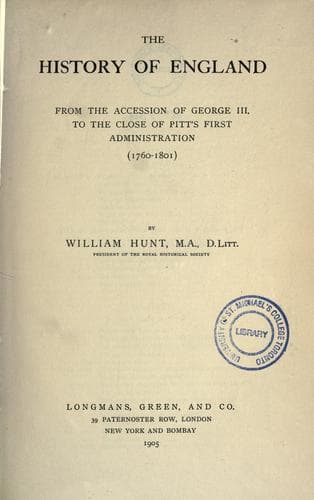
The history of England, from the accession of George III. to the close of Pitt's first administration, 1760-1801Hunt, William
History
The history of England, from the accession of George III. to the close of Pitt's first administration, 1760-1801
Hunt, William
Great Britain -- History -- George III, 1760-1820
The house reassembled after the Christmas recess on January 12. Fox
relying on the authority of Lord Somers, one of the leading statesmen of
the revolution, questioned the right of the crown to dissolve parliament
during the business of a session; James II., he said, had done so and
put an end to his reign. His contention was unsound; the will of a house
of commons is not conclusive: the crown has a right to dissolve in order
to ascertain the will of the nation. Pitt replied that he "would not
compromise the royal prerogative or bargain it away in the house of
commons". He was in a minority of 193 to 232. On the 14th, he brought in
his India bill, which proposed to place the political concerns of the
company under a board of control in England to be appointed by the
crown, and to leave to the company its commerce and patronage. Fox
attacked it as incomplete, and it was negatived though only by eight
votes. A fierce struggle followed, a struggle, Dr. Johnson called it,
"between George the Third's sceptre and Mr. Fox's tongue". Fox tried
every means to force the ministers to resign; he put forth all his
wonderful powers of debate and attacked Pitt with great bitterness;
addresses to the crown and resolutions hostile to the ministers were
adopted, and the supplies and the mutiny act were postponed. Through it
all Pitt exhibited wonderful courage, sagacity, and self-control. A body
of independent members proposed a compromise, and the king reluctantly
assented. Fox declared himself willing to work with Pitt, but,
determined to assert the authority of the house, insisted that the
ministers should resign before arrangements were discussed. To this Pitt
haughtily refused to assent. George upheld him: during the late
administration he would not create any peers; on Pitt's recommendation
he created four, and almost daily sent his young minister encouraging
little notes. The lords too were on his side; they condemned as
unconstitutional a resolution of the commons suspending certain
statutory powers of the treasury, which was adopted in order to
embarrass the ministry, and sent an address to the king assuring him of
their support in the just exercise of the prerogative.
Public-domain text, read in full here on John Shaqi.
Reviews
Reviews
No reviews yet
Be the first to share your thoughts on this work.
Elsewhere in the archive
Join the Discussion
Join the discussion
Sign in to leave a comment or review.
Sign InorCreate an account