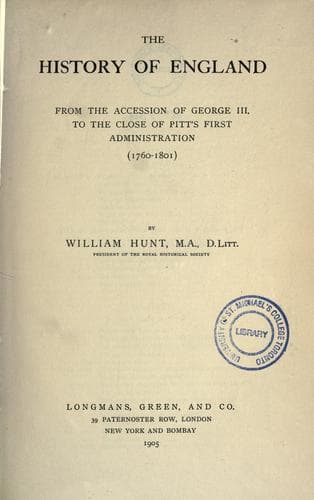
The history of England, from the accession of George III. to the close of Pitt's first administration, 1760-1801Hunt, William
History
The history of England, from the accession of George III. to the close of Pitt's first administration, 1760-1801
Hunt, William
Great Britain -- History -- George III, 1760-1820
He was then in his twenty-fifth year. Extraordinary difficulties faced
him: the opposition of a large majority of the commons, led by Fox, a
master of debate, and strong in men of ability and experience, and the
discredit attaching to the king's unconstitutional action to which he
owed his position. He found it difficult to form a ministry, for few
were willing to join him in a struggle in which victory seemed hopeless.
Shelburne, his former leader, he would not invite, for he could not
endure his habitually enigmatic conduct. Temple, an instigator and the
agent of the king's action, became secretary of state, but immediately
resigned owing apparently to a personal offence. The new cabinet
consisted only of Lords Sydney (Thomas Townshend) and Carmarthen,
secretaries for the home and foreign departments; Gower, president of
the council; Rutland, privy seal; Thurlow, chancellor; and Howe, first
lord of the admiralty; besides Pitt who alone among them sat in the
commons. Richmond again became master of the ordnance and a little later
re-entered the cabinet. Dundas was treasurer of the navy. Pitt's
acceptance of office was regarded by the opposition as a "boyish freak";
his ministry was "a mince-pie administration which would end with the
Christmas holidays".[176]
Pitt had a majority of the commons against him; but in those days the
cabinet was not so wholly dependent on the commons as it became after
1832.[177] Supported by the king and the lords, Pitt determined to do
battle with the majority in the hope that he would overcome their
opposition, discredit his enemies, and win the confidence of the country
before he appealed to it. Fox should have urged an immediate
dissolution. If Pitt had tried to avoid it, he would have incurred the
odium of hesitating to accept the will of the nation. Fox, however, used
every effort to prevent a dissolution. The will of the commons had been
thwarted by the king's unconstitutional interference, and he was
determined to vindicate the authority of the house. Besides, he had a
substantial majority, and though it might have been maintained by a
general election, he knew that his coalition with North was unpopular,
and that his India bill had aroused the hostility of some powerful
corporations which felt that their privileges were endangered by his
attack upon the company's charter. The affairs of India were at once
made a pretext for an address to the crown deprecating a dissolution;
the house was engaged upon them, and a dissolution would frustrate its
endeavours. The king replied that he would not interfere with its work
either by dissolution or prorogation.
[Sidenote: _PITT'S VICTORIOUS CONTEST._]
Public-domain text, read in full here on John Shaqi.
Reviews
Reviews
No reviews yet
Be the first to share your thoughts on this work.
Elsewhere in the archive
Join the Discussion
Join the discussion
Sign in to leave a comment or review.
Sign InorCreate an account