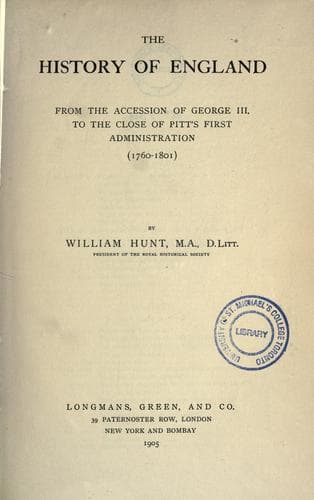
The history of England, from the accession of George III. to the close of Pitt's first administration, 1760-1801Hunt, William
History
The history of England, from the accession of George III. to the close of Pitt's first administration, 1760-1801
Hunt, William
Great Britain -- History -- George III, 1760-1820
Besides the ordinary amusements of society, fashionable people
frequented public assemblies, of which those at Ranelagh were longest in
vogue. The company at Vauxhall was more mixed. People of the
shop-keeping and lower classes enjoyed themselves in the numerous
pleasure resorts about London, such as Mary-le-bone gardens, Islington,
and Sadler's Wells. Theatres were well attended and the increase of
public decency is illustrated by the disappearance from the stage of the
coarseness of earlier times. It was the golden age of the drama; for it
saw the acting of Macklin and Garrick, of Mrs. Siddons, "the tragic
muse," and her brother John Kemble, of Mrs. Abington, Miss Farren, "the
comic muse," afterwards Countess of Derby, and Mrs. Jordan. As
dramatists Home, Foote, Colman, and Cumberland deserve to be mentioned;
and Goldsmith and Sheridan wrote comedies which, while belonging to
acting drama, adorn English literature. Among less respectable
amusements bull-baiting was confined to the lowest class. An attempt to
render it illegal was defeated in parliament in 1800, chiefly through
the opposition of Windham. Cock-fighting, though widely condemned, was
practised even by gentlemen, chiefly as a means of betting. Exhibitions
of combats with swords became extinct, and made way for the scarcely
less dangerous prize-fights of bruisers which from about 1788 became
extremely popular.
Foreign travel, which earlier was almost confined to the "grand tour"
made by rich young men as part of their education, increased greatly
before the revolutionary war, and travelling in England became more
general as the means of communication were improved. In 1760 English
roads were little better than they were a century before, mere
trackways, which in parts were sloughs in winter and scored with deep
ruts in summer. Travelling over them was slow and often dangerous. The
"flying-machine," or coach, between London and Sheffield was fully three
days on its journey. During the first fourteen years of the reign 452
acts were passed for repairing roads, but for some time little progress
was made. Many and bitter are the complaints made by Arthur Young, the
eminent agriculturist, of the roads on which he travelled in 1769-70.
One turnpike road was a bog with a few flints scattered on top, another
full of holes and deep ruts, while "of all the cursed roads which ever
disgraced this kingdom" that between Tilbury and Billericay was, he
says, the worst, and so narrow that when he met a waggon, the waggoner
had to crawl between the wheels to come to help him lift his chaise over
a hedge. During the last quarter of the century a vast change was
effected; good roads became general, and coaches with springs and
otherwise well appointed ran between London and most considerable towns,
and between one large town and another. From 1784 many of these coaches
carried the mails, and letters posted in Bath were delivered in London
seventeen hours later.
[Sidenote: _POETRY._]
Public-domain text, read in full here on John Shaqi.
Reviews
Reviews
No reviews yet
Be the first to share your thoughts on this work.
Elsewhere in the archive
Join the Discussion
Join the discussion
Sign in to leave a comment or review.
Sign InorCreate an account