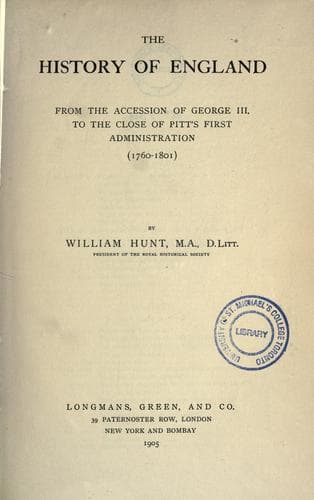
The history of England, from the accession of George III. to the close of Pitt's first administration, 1760-1801Hunt, William
History
The history of England, from the accession of George III. to the close of Pitt's first administration, 1760-1801
Hunt, William
Great Britain -- History -- George III, 1760-1820
The wider outlook acquired by travel contributed to an increase of
intellectual activity, and improved means of internal communication
assisted the dissemination of books. People read more; many instructive
books met with a large sale, and circulating libraries were established
in the larger towns. In literature the period is marked by an advance in
the transition from artificiality of thought, and still more of
expression, to what was natural and spontaneous. Antiquity began to
attract, and romanticism gradually gained ground. Thomson, who led the
flight of poetry from the gilded house of bondage, wrote at an earlier
time than ours. For us the new feeling is illustrated by the popularity
of _Ossian_, Bishop Percy's _Reliques_, Gray's romantic lyrics, and the
pseudo-antique poems of Chatterton, a Bristol lad who killed himself in
1770. Goldsmith's poetry belongs to the old school, for he was a
follower of Johnson, a strenuous opponent of the new romanticism. The
poetry of Cowper, an ardent lover of nature, whose first volume appeared
in 1781, though usually conventional in expression, is always sincere
and sometimes exquisite. Crabbe, a story-teller and preacher, wrote some
true poetry, along with much that is prosaic: rarely moved by an
inspiration drawn from nature to desert the conventional couplet, he
nevertheless had something of the spirit of the new movement. In 1783
the artist-poet Blake began to write verse which is absolutely
untrammelled by convention, mystical, strange, and unequal. Three years
later a volume by Robert Burns, the national poet of Scotland, contained
the outpouring of a passionate soul in musical verse, and in 1798, two
years after his death, the victory of the romantic school was secured by
the publication of the _Lyrical Ballads_ of Wordsworth and Coleridge,
though its triumph was not confirmed until a few years later.
Public-domain text, read in full here on John Shaqi.
Reviews
Reviews
No reviews yet
Be the first to share your thoughts on this work.
Elsewhere in the archive
Join the Discussion
Join the discussion
Sign in to leave a comment or review.
Sign InorCreate an account