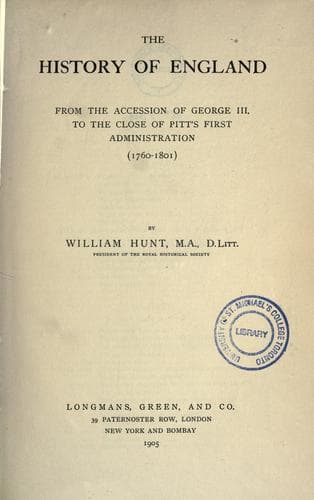
The history of England, from the accession of George III. to the close of Pitt's first administration, 1760-1801Hunt, William
History
The history of England, from the accession of George III. to the close of Pitt's first administration, 1760-1801
Hunt, William
Great Britain -- History -- George III, 1760-1820
Within the Church rapid progress was made by the evangelical movement.
Many of the earlier evangelical clergy were methodists, some workers
with Wesley, others preachers of Lady Huntingdon's "connexion" before
her secession in 1781. During the last two decades of the century the
evangelicals became distinct from the methodists and formed an
increasing body inside the Church. Among its clerical chiefs were
Romaine, Venn, Cecil, and Newton of Olney, the spiritual guide of many
of its leading adherents; it owed much to Lord Dartmouth's patronage,
Cowper's poetry presented its doctrine in a pleasing form, Hannah More
furthered its cause by her writings, and Wilberforce brought it into
connexion with political life. Only one of the avowed evangelical
clergy, Isaac Milner, Dean of Carlisle, received dignified preferment
before 1800, for the king was averse from "enthusiasm," and though
Pitt's Church appointments were eminently respectable, he does not seem
to have been guided in making them by any exalted consideration.
Whatever the failings of the evangelical party may have been, it
certainly exercised a strong and wholesome influence on the national
life, which was aided by the effects of the war with France. Not only
did the discipline of war sober the nation, but it also extended the
revolt against unreality which took place in the domains of literature
and art, to that of religion, and brought people to accept a teaching
which appealed more strongly to the heart than that of the older school
of clergy. While most of the work of the evangelicals lies outside our
subject, the character of its influence on society may be gathered from
their efforts for the suppression of the slave trade; from the stricter
observance of Sunday which became general towards the end of our period;
from their plans for bettering the condition, and their care for the
education of the poor. The institution of Sunday schools was largely due
to Robert Raikes, of Gloucester, who began his work in 1780. Six years
later some 200,000 children attended these schools, and in many cases
gained in them their only education. The work was encouraged by the king
and queen, and along with other efforts for the education of the poor
was helped forward by Hannah More, Wilberforce, and other evangelicals.
Public-domain text, read in full here on John Shaqi.
Reviews
Reviews
No reviews yet
Be the first to share your thoughts on this work.
Elsewhere in the archive
Join the Discussion
Join the discussion
Sign in to leave a comment or review.
Sign InorCreate an account