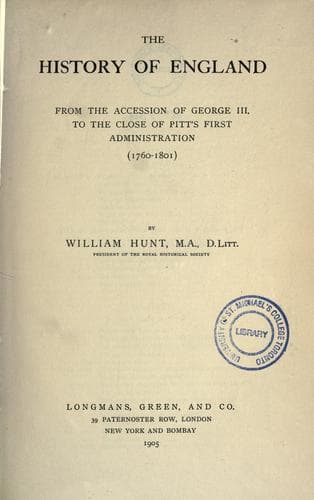
The history of England, from the accession of George III. to the close of Pitt's first administration, 1760-1801Hunt, William
History
The history of England, from the accession of George III. to the close of Pitt's first administration, 1760-1801
Hunt, William
Great Britain -- History -- George III, 1760-1820
Apart from any religious movement, many laymen, among whom Burke holds a
high place, strove to soften the hardness and cruelty of the age. There
was need of their efforts. The criminal law was fearfully severe. Early
in the reign as many as 160 crimes were capital felonies, and the number
was constantly augmented. A theft of more than the value of twelve
pence by picking a pocket was punishable by death. This severity led to
an increase of crime. The injured would not prosecute, juries would not
convict on clear evidence, judges recommended to mercy, and criminals
were emboldened by the chances of escape. The heavy punishments attached
to light offences tended to multiply serious crimes; for a thief who
knew that he might be hanged was tempted to commit murder rather than be
caught. Though only about a fifth of the capital sentences were carried
out, executions were terribly numerous, especially between 1781 and
1787. In 1783, at two consecutive executions, twenty persons were hanged
together. Ninety-six were hanged at the Old Bailey in ten months in
1785, and at the Lent assizes of that year there were twenty-one capital
sentences at Kingston, twelve at Lincoln and sixteen at Gloucester, and
in each town nine persons were hanged. Executions were popular
spectacles; 80,000 persons are said to have been present at one at
Moorfields in 1767, and over 20,000 assembled at Tyburn in 1773 to see a
woman burnt--she was previously strangled at the stake--for the murder
of her husband. The ghastly procession to Tyburn was stopped in 1783,
and executions were ordered to be carried out in front of the prison;
and in 1790 the burning of women was abolished. Otherwise, in spite of
Burke's efforts, the criminal law was not materially ameliorated till
the next century. The punishment of the pillory was one of its worst
abuses. When inflicted for some popular act, such as libelling a
minister, the offender was treated as a hero, but if a man's crime
outraged the moral sense of the mob, he was exposed to horrible
barbarity. Two men were pelted to death, in 1763 and 1780, on the
pillory in London. After the second of these murders Burke brought the
matter before parliament; he was supported by Sir Charles Bunbury, who
quoted a similar case at Bury, but the punishment was not abolished.
Whipping was constantly inflicted, not merely on men but on women, and
in public as well as privately. The poor were brutalised by cruel and
indecent punishments, and were far too much under the power of
magistrates, some of them vicious and ignorant men, who had summary
jurisdiction in a large number of criminal cases.
[Sidenote: _PRISONS AND POLICE._]
Public-domain text, read in full here on John Shaqi.
Reviews
Reviews
No reviews yet
Be the first to share your thoughts on this work.
Elsewhere in the archive
Join the Discussion
Join the discussion
Sign in to leave a comment or review.
Sign InorCreate an account