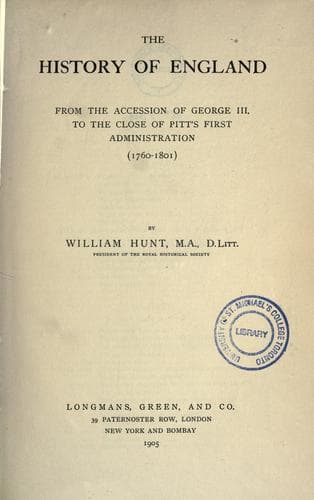
The history of England, from the accession of George III. to the close of Pitt's first administration, 1760-1801Hunt, William
History
The history of England, from the accession of George III. to the close of Pitt's first administration, 1760-1801
Hunt, William
Great Britain -- History -- George III, 1760-1820
The population outgrew the police system. Riots were frequent in times
of scarcity or popular excitement, and often could only be quelled by
soldiers. Throughout the whole of our period highwaymen infested the
roads; in 1774 Horace Walpole at Twickenham declared that it was
scarcely safe to venture out by day; Lady Hertford had been attacked on
Hounslow Heath at three in the afternoon. Some daring robberies, two of
them of mails, were effected in 1791. In the earlier years of the reign
smuggling was carried on with amazing audacity, specially on the south
and east coasts. It was calculated that 40,000 persons were engaged in
it by sea and land, and that two-thirds of the tea and half the brandy
consumed in England paid no duty. Bands of armed smugglers rode up to
London with their goods, and attempts to interfere with their trade were
fiercely and often successfully resisted. Smuggling, however, was
checked, as we shall see, by the wise policy of Pitt. The weakness of
the police caused an alarming increase of crimes against property;
footpads stopped carriages even in Grosvenor Square and Piccadilly, and
in 1792 the streets are said on good authority to have been unsafe by
night. With the exception of a few Bow street officers and some mounted
patrols, the only police in London were parish constables and the
watchmen, many of them old and decrepit. The magistracy of Middlesex had
largely fallen into the hands of men described by Burke as "the scum of
the earth," who used their office as a means of getting gain, and
frightful abuses were common.[179] In 1792 parliament established
stipendiary magistrates appointed by the crown for the London police
courts, and a few police officers were attached to each court. This
important reform would have been more effective if a larger number of
police had been placed under the orders of the new magistrates, for
after that date the police of London and its immediate neighbourhood
consisted of not more than 2,044 watchmen and patrols and 1,000
constables and other officers, of whom only 147 received pay and gave
their whole time to police work.[180]
Public-domain text, read in full here on John Shaqi.
Reviews
Reviews
No reviews yet
Be the first to share your thoughts on this work.
Elsewhere in the archive
Join the Discussion
Join the discussion
Sign in to leave a comment or review.
Sign InorCreate an account