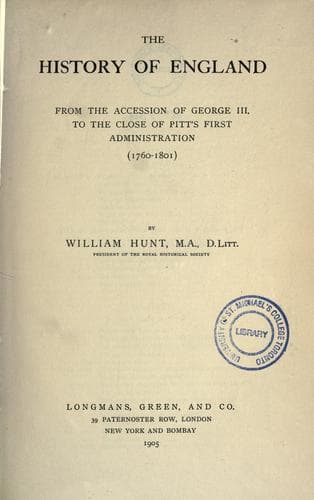
The history of England, from the accession of George III. to the close of Pitt's first administration, 1760-1801Hunt, William
History
The history of England, from the accession of George III. to the close of Pitt's first administration, 1760-1801
Hunt, William
Great Britain -- History -- George III, 1760-1820
The prisons were horrible dens in which felons and debtors, men and
women, old and young, were crowded together. Many of them had no
water-supply and very little air; some had no sewers, and where sewers
existed they were generally choked up. Great numbers died of gaol-fever
and small-pox. In about half the county gaols debtors had no allowance
of bread. Everywhere prisoners were exposed to extortion, and were
sometimes detained in gaol after acquittal for non-payment of the
gaolers' fees. Such was the state of things in 1773 when John Howard
began to inquire into the condition of the prisons. He roused the
attention of parliament and of the public to these abuses, and by 1779
some of the more flagrant of them were removed. He spent the remainder
of his life in efforts to reform the prisons, and accomplished much,
though much still remained to be done. After 1776 convicts could no more
be transported to America, and male convicts were kept in hulks on the
Thames and elsewhere. These hulks soon became overcrowded, and in 1784
the old system of assigning convicts to employers in different parts of
the British dominions oversea was again adopted. The evils of this
system were recognised, and it was decided to send criminals sentenced
to transportation to New South Wales. A government was established;
Captain Phillip, of the navy, was appointed governor, and in 1787 took
out the "first fleet" with convicts. He established a settlement at Port
Jackson, and founded a city which he called Sydney, after the then
secretary for home affairs. Such was the unworthy beginning of the
present magnificent colony of New South Wales.
Public-domain text, read in full here on John Shaqi.
Reviews
Reviews
No reviews yet
Be the first to share your thoughts on this work.
Elsewhere in the archive
Join the Discussion
Join the discussion
Sign in to leave a comment or review.
Sign InorCreate an account