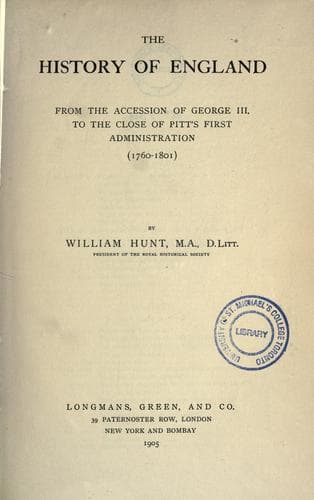
The history of England, from the accession of George III. to the close of Pitt's first administration, 1760-1801Hunt, William
History
The history of England, from the accession of George III. to the close of Pitt's first administration, 1760-1801
Hunt, William
Great Britain -- History -- George III, 1760-1820
The war was going on gloriously under Pitt's direction. Our ally,
Frederick of Prussia, was, indeed, in distress in spite of his
hard-earned victory at Torgau, for his resources were exhausted, and
half his dominions were occupied by his enemies. During 1761 Prince
Henry made no progress in Saxony. Frederick himself lost Schweidnitz,
and, with it, half Silesia, while the fall of Colberg left the Russians
free either to besiege Stettin in the following spring, or to seize on
Brandenburg. In Western Germany, however, where a British army was
serving under Prince Ferdinand of Brunswick in the defence of Hanover
against the French, a signal success was gained. Early in the year the
allies entered Hesse, and forced the French to retreat almost to the
Main. Nevertheless they failed to take Cassel, the chief object of the
campaign, and were obliged to retire from Hesse. In June two French
armies, under Marshal de Broglie and Prince Soubise, effected a junction
at Paderborn, advanced to Soest, and threatened Lippstadt. Ferdinand
took up a position between the Lippe and the Ahse at Vellinghausen. On
July 15 he was attacked by the French. The enemy engaged his left wing,
formed by the British troops under their commander, the gallant Marquis
of Granby. The attack was splendidly met and finally repulsed. The
battle was renewed the next morning at daybreak, and the allies gained a
complete victory. The British troops, who formed about a fourth part of
the allied army, highly distinguished themselves; Maxwell's grenadiers
alone captured four French battalions. This victory, won against heavy
odds, foiled the most serious attempt of the French against Hanover; it
saved Lippstadt, which would have been exceedingly useful to them as a
depot; and, more than that, it caused a quarrel between Broglie and
Soubise, which ended in the recall of Broglie, by far the abler of the
two generals. Meanwhile they parted company; Soubise did much mischief
in Westphalia, and Broglie campaigned to the east of the Weser. The
French kept their hold on Gottingen and Cassel, and were therefore in a
position to renew their attacks on Hanover the following year.
[Sidenote: _CAPTURE OF BELLE ILE._]
Public-domain text, read in full here on John Shaqi.
Reviews
Reviews
No reviews yet
Be the first to share your thoughts on this work.
Join the Discussion
Join the discussion
Sign in to leave a comment or review.
Sign InorCreate an account