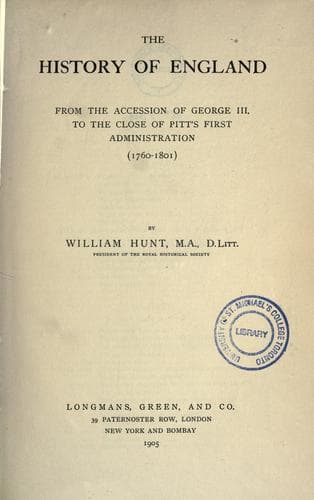
The history of England, from the accession of George III. to the close of Pitt's first administration, 1760-1801Hunt, William
History
The history of England, from the accession of George III. to the close of Pitt's first administration, 1760-1801
Hunt, William
Great Britain -- History -- George III, 1760-1820
George's popularity was impaired by the influence exercised over him by
his mother and Bute, which excited the ridicule of the higher class of
society and the bitter feelings of the London populace. Bystanders
sneered when they saw him on his way to visit his mother, and it is said
that on one occasion he was insulted with a coarse jest. In Bute's case
the idea that he was the royal favourite would alone have sufficed to
make him hated. The term was generally applied to him. Yet he was not a
favourite in the more odious sense of the word, for though the king
showed him signal favour, their relations were rather political than
personal. His nationality strengthened the dislike with which he was
regarded. The jacobite troubles had increased the prejudices of the
English against the Scots; they looked down upon them as a
half-barbarous people, poor, and greedy to enrich themselves with the
wealth of England. Scorn and indignation were aroused by the grants of
honours and employments made to Bute's Scottish followers who came in
great numbers to the court under his patronage. Bills were posted in
London with the words: "No petticoat government! No Scotch minister! No
Lord George Sackville!" Any unpopular measure was set down to Bute's
advice. The beer-tax was believed to have been suggested by him, and
provoked a disturbance in the theatre in the king's presence, which
caused Bute much annoyance. He was yet to rise higher in the state, and
to arouse more violent feelings of hatred and contempt.
FOOTNOTES:
[1] Mahan, _The Influence of Sea Power upon History_, pp. 318-19.
[2] Earl Waldegrave's _Memoirs_, p. 36.
[3] See, for example, "Memorandum of what past at Sir R. Walpole's
house," Sept. 9, 1725, Add. MS. 32,687 (Duke of Newcastle's Papers), f.
155.
[4] _Engl. Historical Rev._, xvii. (1902), 678 _sqq._, an interesting
article by Mr. Winstanley to which I am indebted.
[5] Add. MS. 32,914, ff. 171, 189; the order in the text is that of the
manuscript, the names and offices within parentheses are supplied.
[6] His appointment about Nov. 16, Add. MS., _u.s._, f. 369; he appears
as a "lord of the cabinet," Jan. 8, 1761, Add. MS. 32,917, f. 180.
[7] Add. MS. 32,929, f. 143; see also _Engl. Hist. Rev._, _u.s._
[8] _Dropmore Papers_, iii., 337-38, 341-43 (Hist. MSS. Comm.); Earl of
Malmesbury, _Diaries_, etc., iii., 465.
[9] J. Morley, _Walpole_, p. 157.
[10] From the Revolution the two principal secretaries of state took one
the southern, the other the northern department. Both were responsible
for home affairs. Foreign affairs were divided between them, the
southern department including France, Spain, etc., the northern,
Germany, the Low Countries, Denmark, Sweden, and Russia. A third
secretaryship was established for the colonies in 1768, and abolished in
1782, when the distinction between northern and southern was
discontinued and the secretaryships were divided into home and foreign.
Public-domain text, read in full here on John Shaqi.
Reviews
Reviews
No reviews yet
Be the first to share your thoughts on this work.
Join the Discussion
Join the discussion
Sign in to leave a comment or review.
Sign InorCreate an account