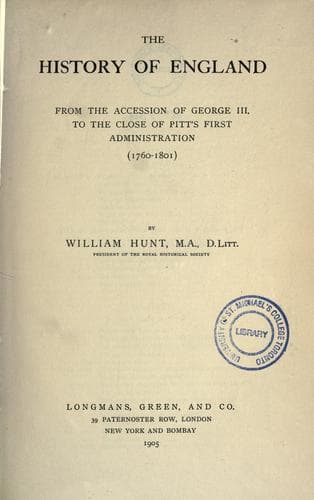
The history of England, from the accession of George III. to the close of Pitt's first administration, 1760-1801Hunt, William
History
The history of England, from the accession of George III. to the close of Pitt's first administration, 1760-1801
Hunt, William
Great Britain -- History -- George III, 1760-1820
By the beginning of 1761 France was anxious for peace, and in concert
with her allies, Austria, Russia, Sweden, and Poland, invited Great
Britain and Prussia to negotiate, and suggested that a congress should
meet at Augsburg. England and Prussia assented, and plenipotentiaries
were appointed. In England the prospect of a peace was hailed with
satisfaction, and the funds rose 4 per cent. The congress never met, but
the plan was not abandoned for some months; and Choiseul, the minister
of Louis XV., sent a memorial to England proposing that, as difficulties
would arise at the congress if the questions in dispute between England
and France were debated along with the affairs of their respective
allies, the two courts should enter on a separate negotiation. He
offered to treat on the basis of _uti possidetis_, that is, that the
possessions of both countries should be acknowledged as regards the
conquests made by the one from the other, and that certain dates in the
current year should be fixed upon as those on which the conquests should
be ascertained. The offer was large; for at that time England had
conquered from France Cape Breton, Canada, Guadeloupe, Mariegalante,
Goree, and Senegal, and had also gained great advantages in India,
though the fall of Pondicherry was not yet known; while France had only
conquered Minorca from England. She had also, it will be remembered,
gained insecure possession of Hesse, Hanau, and Gottingen. England
agreed to a separate negotiation on the basis of _uti possidetis_, but
Pitt would not commit himself as to the dates, for he was preparing the
expedition against Belle Ile, and intended that England should not lose
the advantage which would accrue from its success. He also declared that
his court would not desert the King of Prussia. Choiseul replied that
neither would France desert her allies, and that the negotiation only
concerned the interests of the two powers. On this understanding the two
courts sent representatives the one to the other; the English
representative chosen by Pitt was Hans Stanley, and M. de Bussy was sent
to London by Choiseul.
Public-domain text, read in full here on John Shaqi.
Reviews
Reviews
No reviews yet
Be the first to share your thoughts on this work.
Join the Discussion
Join the discussion
Sign in to leave a comment or review.
Sign InorCreate an account