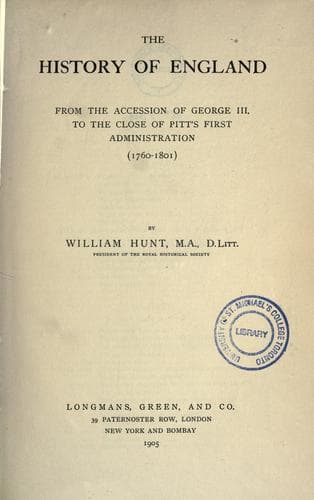
The history of England, from the accession of George III. to the close of Pitt's first administration, 1760-1801Hunt, William
History
The history of England, from the accession of George III. to the close of Pitt's first administration, 1760-1801
Hunt, William
Great Britain -- History -- George III, 1760-1820
On the same day as the proceedings in the lords, Grenville brought a
message from the king to the commons informing them of what had been
done in Wilkes's case. They voted, 273 to 111, that the _North Briton_,
No. 45, was a false and seditious libel, and ordered that it should be
burnt by the common hangman. In the course of the debate, Martin, who
had lately been secretary to the treasury, called Wilkes a cowardly and
malignant scoundrel. The next day, the 16th, they fought a duel with
pistols in the ring in Hyde Park; they had no seconds and each fired
twice. Martin's second shot wounded Wilkes dangerously. In his absence
the commons discussed his plea of privilege. Pitt strongly urged the
house to maintain its privileges. Parliament, he said, had no right to
surrender them; if it did so it would endanger its own freedom and
infringe upon the rights of the people. As for Wilkes personally, Pitt
was anxious to show that he did not approve of Temple's support of him,
and called him "the blasphemer of his God and the libeller of his king".
The house voted by 258 to 133 that privilege of parliament does not
extend to seditious libels, and ought not to obstruct the ordinary
course of the law in such cases. In itself this was an excellent
decision. Parliamentary privileges had increased to a mischievous
extent. By the abandonment of many of them, such as certain invidious
exemptions from the course of law which it claimed for its members, the
exclusion of strangers from its debates, and the prohibition of
reporting, parliament has gained in dignity and purity, and has
confirmed the liberties of the people. Nevertheless, though the
abandonment of privilege was in itself a step in a right direction, it
was reprehensible in Wilkes's case, because it was an _ex post facto_
measure, designed to meet a special case, and vindictive in its
intention.
Public-domain text, read in full here on John Shaqi.
Reviews
Reviews
No reviews yet
Be the first to share your thoughts on this work.
Elsewhere in the archive
Join the Discussion
Join the discussion
Sign in to leave a comment or review.
Sign InorCreate an account