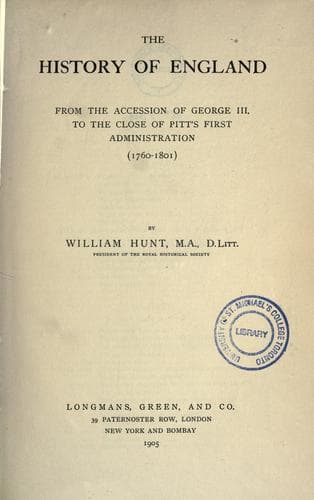
The history of England, from the accession of George III. to the close of Pitt's first administration, 1760-1801Hunt, William
History
The history of England, from the accession of George III. to the close of Pitt's first administration, 1760-1801
Hunt, William
Great Britain -- History -- George III, 1760-1820
The lords agreed in the decision of the commons, though a protest
against the surrender of privilege was signed by seventeen peers. On
December 3, the day fixed for the burning of No. 45 in front of the
Royal Exchange, a large mob broke the windows of the sheriff's coach and
pelted the constables. Encouraged by gentlemen at the windows of
neighbouring houses, they tore a large part of the paper from the
executioner with shouts of "Wilkes and liberty," carried it in triumph
outside Temple Bar, the boundary of the city, and there made a bonfire
into which they threw a jack-boot and a petticoat, the popular emblems
of Bute and the Princess of Wales. Yet Wilkes was in an unpleasant
position. A Scot went to his house intending to murder him; was arrested
and found insane. A summons was sent to him to appear at the bar of the
house of commons; his surgeons stated that he was too ill to attend, and
a later day was fixed. Before it came he went off secretly to Paris, and
while there excused himself from obedience to the order of the house by
sending a medical certificate. The commons refused to give any weight to
it, declared him in contempt, and guilty of a seditious libel, and on
January 19, 1764, expelled him the house. An information was laid
against him in the court of king's bench for reprinting and publishing
No. 45; he was convicted and, as he did not appear to receive sentence,
was outlawed.
While little sympathy seems to have been felt for Wilkes personally,
except among the lower classes, the attack upon him was widely resented
because it was regarded as an encroachment on national liberty.
Parliament was not in accord with public feeling. A strong effort was
made to induce the commons to declare that general warrants were
illegal. Pitt acknowledged that he had issued them during the war, when
it was necessary to find out and remove suspected persons; but no such
necessity existed at present, and he urged the house to do justice to
the nation, the constitution, and the law, by condemning them. The
ministers managed to shelve the question, but carried the adjournment
only by 234 to 218. Though on other matters they commanded a large
majority, several members from whom they expected support voted against
them in the debates arising out of Wilkes's arrest. Among these were
General Conway and Colonel Barre. Conway, the brother of the Earl of
Hertford, had gained much credit in the war in Germany; he was a dashing
officer and a respectable general, a man of refined tastes and high
principles. As a politician he was thoroughly honest, of small ability
and utterly wanting in decision of character. He was the dearest friend
of Horace Walpole; and Walpole, who regarded politics in a personal
light, exercised an unfortunate influence upon him. Barre, who had
served with distinction in Canada, was a coarse man, eloquent, and
feared by his opponents on account of his remarkable power of invective.
Public-domain text, read in full here on John Shaqi.
Reviews
Reviews
No reviews yet
Be the first to share your thoughts on this work.
Elsewhere in the archive
Join the Discussion
Join the discussion
Sign in to leave a comment or review.
Sign InorCreate an account