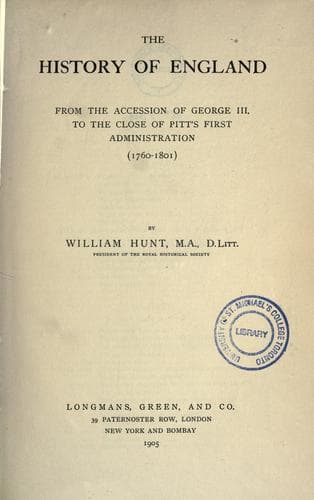
The history of England, from the accession of George III. to the close of Pitt's first administration, 1760-1801Hunt, William
History
The history of England, from the accession of George III. to the close of Pitt's first administration, 1760-1801
Hunt, William
Great Britain -- History -- George III, 1760-1820
He sat for one of Shelburne's boroughs, and believing himself slighted
by Pitt, attacked him vehemently in the house on his resignation of
office. As a supporter of Bute he was appointed adjutant-general and
governor of Stirling, posts worth L4,000 a year. George, who regarded a
vote against the ministers in this matter as a personal affront to
himself, was determined that all who held either military or civil
appointments should clearly understand that they could not continue to
serve him if they opposed his policy in parliament. With Bedford's
approval, Conway, Barre, and with them General A'Court, who had also
voted in the minority, were deprived of their commands, and Shelburne,
Barre's patron, was dismissed from his office as aide-de-camp to the
king. Barre followed Shelburne's example in attaching himself to Pitt.
[Sidenote: _GRENVILLE'S ECONOMY._]
These dismissals violated the most valuable of the privileges of
parliament, freedom of speech and immunity from royal coercion. It was a
well-established constitutional rule that the king should not take
notice of anything which passed in parliament and that no member should
suffer for his speeches or votes. This rule had been broken in the last
reign when, in 1733, two officers lost their commands and, in 1735, Pitt
his cornetcy for acting with the opposition. On the present occasion the
responsibility for its violation rests on Grenville at least as much as
on the king himself. Parliament took little notice of this infringement
upon its privileges, though on the first day of the session, 1765,
Granby pleased the army by some sharp remarks on the dismission of
officers on account of their votes in parliament.[67] Encouraged by
their success against Wilkes, the ministers waged war on political
libels. A large number of _ex officio_ informations, or accusations
presented by the attorney-general on which the person accused was
brought to trial without the previous finding of a grand jury, were laid
against printers and others during the course of the year. As this
looked like persecution, it excited popular anger. One bookseller who
was sentenced to stand in the pillory in New-palace-yard, Westminster,
drove thither in a hackney coach numbered 45, and was cheered by a crowd
estimated at 10,000 persons. Two hundred guineas was collected for him,
and the mob hung a jack-boot and a "Scotch bonnet" on a gibbet and then
burnt them.
Public-domain text, read in full here on John Shaqi.
Reviews
Reviews
No reviews yet
Be the first to share your thoughts on this work.
Elsewhere in the archive
Join the Discussion
Join the discussion
Sign in to leave a comment or review.
Sign InorCreate an account