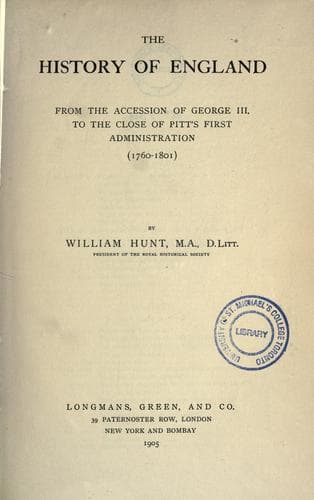
The history of England, from the accession of George III. to the close of Pitt's first administration, 1760-1801Hunt, William
History
The history of England, from the accession of George III. to the close of Pitt's first administration, 1760-1801
Hunt, William
Great Britain -- History -- George III, 1760-1820
The freedom which they enjoyed did not extend to commerce and
manufactures. In those matters the policy of Great Britain was founded
on the "mercantile theory," then universally accepted, and was directed
towards securing a monopoly of trade. Other countries pursued a like
policy towards their colonies, though they treated them with far less
liberality. The restrictions placed by Great Britain on colonial trade
were based on the Navigation acts of 1660 and later years, which were
originally aimed at the maritime power of the Dutch. Briefly, they
confined trade with the colonies to English or colonial ships; the
Americans were debarred from exporting a number of the most important
products of their country, their tobacco, grain, sugar, hides, and
timber for masts, except to Great Britain; no foreign ship might enter
their harbours, nor, with certain exceptions, could they import foreign
merchandise, except in ships sailing directly from England. Various acts
debarred them from manufactures which would have entered into
competition with English goods; they depended on the mother-country for
the commonest and most necessary things, for their cloth, hardware, and
a host of manufactured articles. Port duties were imposed by England,
and were collected by officers of the customs, whose business it was to
prevent contraband trading. These duties were not imposed for the sake
of revenue, but for the regulation of trade; and the whole system of
restrictions was founded on the idea that colonies should be made to
serve the interest of the mother-country by giving its merchants and
manufacturers the monopoly of the colonial market.
Public-domain text, read in full here on John Shaqi.
Reviews
Reviews
No reviews yet
Be the first to share your thoughts on this work.
Elsewhere in the archive
Join the Discussion
Join the discussion
Sign in to leave a comment or review.
Sign InorCreate an account