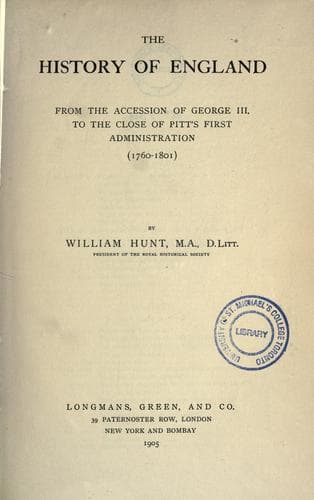
The history of England, from the accession of George III. to the close of Pitt's first administration, 1760-1801Hunt, William
History
The history of England, from the accession of George III. to the close of Pitt's first administration, 1760-1801
Hunt, William
Great Britain -- History -- George III, 1760-1820
The colonies received some compensations for the restrictions placed
upon their industry and commerce. With certain exceptions their trade
was free. While some of their products were confined to the British
market, they had the monopoly of that market; no Englishman, for
example, might buy tobacco which did not come from America or Bermuda.
Their export trade to England was encouraged by bounties, and, though
their foreign imports generally had to come to them through England, a
system of drawbacks, by which the duties were remitted on exportation to
America, enabled them to buy continental goods more cheaply than they
could be bought in England. Nothing indeed can be further from the truth
than the idea that England's treatment of her colonies was harsh or
illiberal. Unfortunately the mercantile theory set up an opposition
between the interests of a mother-country and her colonies. A far more
important mitigation of the restrictions imposed on the colonies than
any that came from English liberality, was derived from the constant
violation of them. Few English statesmen knew or cared to know anything
about colonial affairs. Left to themselves the American colonies grew
rich. Their merchants, especially in New England, carried on a brisk and
extremely profitable contraband trade. In exchange for lumber, fish, and
cattle the New England merchants obtained sugar and molasses, and
bullion from the French and Spanish colonies; and vast quantities of rum
were distilled in Boston and exported to Africa to be used in the slave
trade.
Public-domain text, read in full here on John Shaqi.
Reviews
Reviews
No reviews yet
Be the first to share your thoughts on this work.
Elsewhere in the archive
Join the Discussion
Join the discussion
Sign in to leave a comment or review.
Sign InorCreate an account