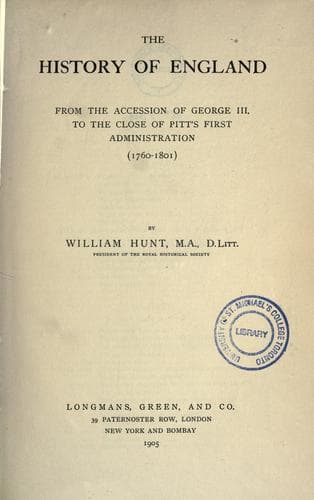
The history of England, from the accession of George III. to the close of Pitt's first administration, 1760-1801Hunt, William
History
The history of England, from the accession of George III. to the close of Pitt's first administration, 1760-1801
Hunt, William
Great Britain -- History -- George III, 1760-1820
These orderly proceedings were accompanied by outbursts of lawless
violence. Societies for resistance were organised. The "sons of
liberty," as they called themselves in reference to Barre's speech, were
active in Boston, and in August, 1765, a mob plundered the house of a
man who was nominated as a distributor of stamps, destroyed a building
on his land which they believed was to be used as a stamp-office, hanged
him in effigy, and forced him to renounce his appointment. A sermon
preached by Jonathan Mayhew, a popular unitarian minister, on the words
"I would that they were even cut off which trouble you," was followed by
a more serious riot. Public buildings were attacked, the records of the
admiralty court were burnt, and the rioters forced their way into the
custom-house and got at the liquor in the cellars. Maddened by drink
they wrecked the stately mansion of Hutchinson, the lieutenant-governor,
and destroyed his fine collection of books and manuscripts. Persons of
good position more or less openly encouraged these excesses and no one
was punished for them. Outbreaks of mob violence, though of a less
riotous kind, took place in Rhode Island, Connecticut, and elsewhere. On
November 1, the day on which the stamp act came into operation, copies
of it were offered for sale headed, "The folly of England and the ruin
of America," bells were tolled, and mock funerals passed through the
streets.
Everywhere the new stamps were seized and destroyed. At New York the
lieutenant-governor, encouraged by the presence of the king's troops,
tried to secure the stamps sent to the town. A riot ensued. General
Gage, the commander-in-chief, declined to interfere at the risk of
beginning a civil war, and the stamps were surrendered and locked up in
the town hall. Besides these not a parcel of stamps was left in the
colonies. For a time this put an end to legal business, and the courts
were closed. Then lawyers agreed to take no notice of the lack of stamps
on documents, and at last the governors declared that the operation of
the act was to be reckoned as suspended. Retaliatory measures were
concerted. Merchants combined to stop all importation from England,
cancelled their orders and delayed sending remittances. Associations
were formed for abandoning the use of English goods, and the richest
citizens either wore old clothes or rough material of colonial
production. Manufactories of linen, cloth, and hardware were started,
and in order to insure a supply of wool, butchers were forbidden by
their customers to kill lambs.
Public-domain text, read in full here on John Shaqi.
Reviews
Reviews
No reviews yet
Be the first to share your thoughts on this work.
Elsewhere in the archive
Join the Discussion
Join the discussion
Sign in to leave a comment or review.
Sign InorCreate an account