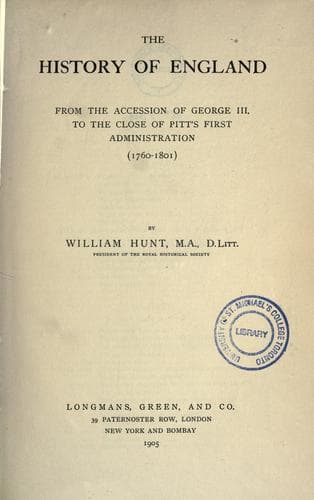
The history of England, from the accession of George III. to the close of Pitt's first administration, 1760-1801Hunt, William
History
The history of England, from the accession of George III. to the close of Pitt's first administration, 1760-1801
Hunt, William
Great Britain -- History -- George III, 1760-1820
The distinction made by the party of resistance between external and
internal taxation was in accordance with previous practice. Though
parliament had frequently imposed port-duties on the colonies, it had
abstained from imposing taxes within them. The stamp act was a new
departure. English history afforded ground for the distinction, which
was alleged in Bate's case, in the reign of James I., in support of the
claim of the crown. Yet it is clearly artificial, for a division of
taxes, such as into external and internal, only concerns their
incidence; it is a matter which belongs to economics and does not affect
political right. The colonists' claim of exemption from parliamentary
taxation on the ground of non-representation appeals to the sympathy of
Englishmen. Both in England and America there were some who desired that
the colonies should be represented in parliament, but their distance
from England and the ignorance of both peoples as regards the
circumstances and needs of each other would have been fatal objections
to any such scheme. The claim of the colonists seems to imply a
misapprehension of the character of parliament; for parliament is not a
mere meeting of delegates, it is an imperial assembly, and its
sovereignty is neither derived from the perfection of its constitution
nor lessened by its imperfection. Taxation is an attribute of
sovereignty, and parliament had a right to tax the colonies because the
sovereign power resided in it. Where else could it reside? To deny the
right to tax and to admit the right to legislate was inconsistent. How
could parliament, in virtue of its sovereign authority, have a right to
pass a bill ensuring personal freedom in the colonies, and yet have no
right to pass another bill imposing a tax on them? The logical outcome
of the American contention was that all parliamentary legislation
concerning the colonies was null, except so far as they chose to admit
it. Under all their arguments lay the germ of independence, though as
yet the leaders of the agitation loudly professed loyalty.
[Sidenote: _UNSTATESMANLIKE POLICY._]
Public-domain text, read in full here on John Shaqi.
Reviews
Reviews
No reviews yet
Be the first to share your thoughts on this work.
Elsewhere in the archive
Join the Discussion
Join the discussion
Sign in to leave a comment or review.
Sign InorCreate an account