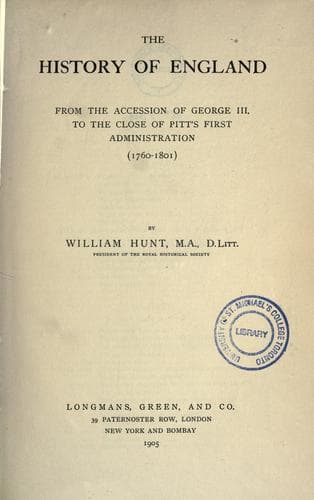
The history of England, from the accession of George III. to the close of Pitt's first administration, 1760-1801Hunt, William
History
The history of England, from the accession of George III. to the close of Pitt's first administration, 1760-1801
Hunt, William
Great Britain -- History -- George III, 1760-1820
Both for public and personal reasons George was anxious to get rid of
his ministers. Unlike them, he appears as early as the spring of 1765 to
have considered the discontent of his American subjects a serious
matter, and he blamed them for it.[68] In other respects, too, he was
dissatisfied with their public conduct, and he complained bitterly of
their behaviour towards himself. In spite of some outward agreement in
action, he and Grenville, who without the name retained nearly all the
authority of prime minister, pursued fundamentally different systems.
Grenville, though not less ready than the king to meet opposition with
violent measures, was imbued with whig theories. While George sought to
rule by securing the support of parliament, Grenville tried to use that
support to enable him to rule the king. He was a pedant, and lectured
the king on his duty like a schoolmaster. Bute stood in his way as the
king's ally and secret counsellor. His victory over him was partial and
short-lived. While Bute was in the country the king corresponded with
him, and he returned to London in the spring of 1764. His return made
the ministers uneasy, and Grenville's lectures became intolerable. "When
he has wearied me for two hours," George complained, "he looks at his
watch to see if he may not tire me for an hour more." Bad as their
public conduct was, he and his colleagues owed their fall chiefly to
their unbecoming behaviour to their sovereign.
[Sidenote: _THE REGENCY BILL._]
Early in 1765 the king had a severe illness and showed signs of the
insanity from which he suffered later. He recovered in March, and as he
believed that his life was not likely to be prolonged, he was anxious to
provide for a possible regency. Constitutional usage pointed to the
queen as the proper person to be regent during the infancy of her son.
George, however, wished to have the power to nominate a regent by an
instrument revocable at pleasure. Grenville dissuaded him from this
idea, and, with his ministers' consent, he announced from the throne
that a bill would be laid before parliament restricting the regency to
the queen and other members of the royal family usually residing in
England. When the bill was proposed in the lords the question was raised
whether the king's mother was a member of the royal family, or only
those in the order of succession. If the Princess of Wales became
regent, Bute would probably regain power. In order to prevent this dire
possibility, Bedford sacrificed decency and common sense by successfully
opposing a motion that the princess's name should expressly be included
in the bill. While the matter was pending, on May 3, Halifax and
Sandwich went to the king and persuaded him that the bill would not pass
the commons unless the princess was excluded. Anxious to save his mother
from insult, George authorised Halifax to move an amendment that only
the queen and those descended from George II. should be capable of the
regency.
Public-domain text, read in full here on John Shaqi.
Reviews
Reviews
No reviews yet
Be the first to share your thoughts on this work.
Elsewhere in the archive
Join the Discussion
Join the discussion
Sign in to leave a comment or review.
Sign InorCreate an account