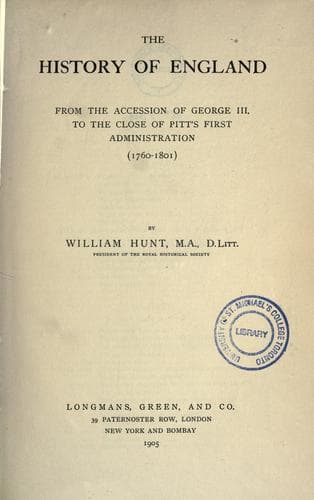
The history of England, from the accession of George III. to the close of Pitt's first administration, 1760-1801Hunt, William
History
The history of England, from the accession of George III. to the close of Pitt's first administration, 1760-1801
Hunt, William
Great Britain -- History -- George III, 1760-1820
That the tax was reasonable in intention, equitable in incidence, and in
itself tolerable, few probably will now deny. Nor will any one surely
deny that the act was foolish and unstatesmanlike. Strict definitions of
legal right are not safe guides in practical politics: sentiment and
circumstances should be held to be of far greater account. The Americans
maintained that there was an important difference between external and
internal taxation, and, in common with all other Englishmen, they highly
valued the right expressed in the maxim, "No taxation without
representation". It was a fatal mistake to disregard their belief and,
for the sake of avoiding a not very serious expenditure, to seem to deny
what they claimed as their heritage as Englishmen. Heavy as its expenses
were, Great Britain could have afforded to take upon itself the sum
required for the defence of the colonies. Grenville could not see the
matter in this light. Well-meaning and wishing to act fairly both
towards England and the colonies, he brought trouble on both alike by
his insistence on legal right. His administration was fruitful in evil.
He permitted parliament to enter on a disastrous struggle with Wilkes in
order to gratify the king; he raised up discord between England and her
most important colonies; he allowed the strength of England to decay by
grudging to spend the money needed for the maintenance of the navy, and
its dignity to be impaired by neglecting to insist on the payment of the
Manila ransom, though for that he was not individually responsible. One
judicious act of his administration may be recorded here. The Isle of
Man, though under the allegiance of the king, was not fully under the
royal authority; the king had no courts and no officers there, and it
was, as Burke said, "the very citadel of smuggling". In 1765 the crown
bought the rights of the Duke and Duchess of Atholl over the island for
L70,000, and it became thenceforward an integral part of the realm of
England.
FOOTNOTES:
[65] Hardwicke to Newcastle, Add. MS. 32,948, f. 54.
[66] G. Rose, _Diaries_, ii., 192.
[67] James Grenville to Lady Chatham, Jan. 12, 1765, MS. Pitt Papers,
35.
CHAPTER IV.
THE KING, THE WHIGS, AND CHATHAM.
Public-domain text, read in full here on John Shaqi.
Reviews
Reviews
No reviews yet
Be the first to share your thoughts on this work.
Elsewhere in the archive
Join the Discussion
Join the discussion
Sign in to leave a comment or review.
Sign InorCreate an account