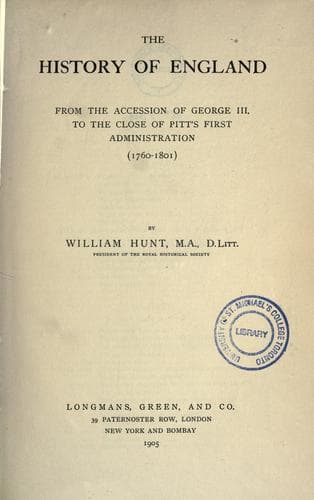
The history of England, from the accession of George III. to the close of Pitt's first administration, 1760-1801Hunt, William
History
The history of England, from the accession of George III. to the close of Pitt's first administration, 1760-1801
Hunt, William
Great Britain -- History -- George III, 1760-1820
Most serious of all was the attitude of Pitt. He was pressed to join the
government; its policy was in many respects such as he could approve,
and in other matters he could almost have made his own terms.
Nevertheless he refused to take office and openly declared his lack of
confidence in the ministers, though they tried to satisfy him in various
ways, such as by obtaining a peerage for Pratt, who was created Baron
Camden. Magnificent as he had shown himself as a dictator, he was
unfitted by temperament to work with others, and his natural defects
were aggravated by his constant attacks of gout. At the same time his
present attitude was to a large extent also a matter of principle. He
would willingly have taken office if he could have simply been the
king's minister, unconnected, without belonging to any party. The
Rockinghams, as they were called, were a party connexion, and under
Rockingham's leadership would remain so, and their character was
emphasised by the inclusion of Newcastle, the chief representative of a
system which Pitt hated, government based on the influence of the whig
houses and not on the good-will of the crown and the people. Pitt
plainly declared that he would not sit at council with Newcastle. Nor
would he take office under Rockingham. Without him the ministry had
neither an original policy nor a chance of permanence. Called into
existence by Cumberland, it leant on him for support; he was present at
all cabinet meetings, and they were sometimes held at his house. His
sudden death on October 31 was a severe shock to the stability of the
government. Pitt would not advise the ministers. Grafton urged that he
should again be invited to take office, but the king would not enter on
a fresh negotiation with him, for he had refused his former overtures
and held very different views from his regarding the American stamp act.
Public-domain text, read in full here on John Shaqi.
Reviews
Reviews
No reviews yet
Be the first to share your thoughts on this work.
Elsewhere in the archive
Join the Discussion
Join the discussion
Sign in to leave a comment or review.
Sign InorCreate an account