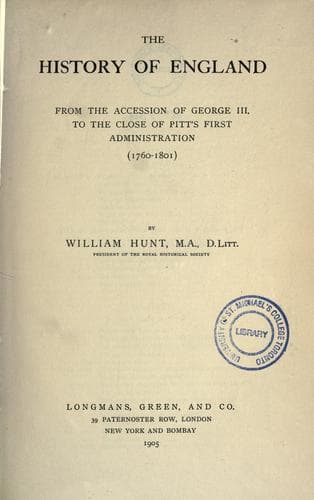
The history of England, from the accession of George III. to the close of Pitt's first administration, 1760-1801Hunt, William
History
The history of England, from the accession of George III. to the close of Pitt's first administration, 1760-1801
Hunt, William
Great Britain -- History -- George III, 1760-1820
For months the ministers paid no heed to American discontent, save that
Conway wrote rather feebly to some of the colonial governors with
reference to the disorders. Parliament was not summoned until December
17, and though the king's speech directed attention to the late
occurrences in the colonies, the ministers had not decided on a policy.
They ascertained Pitt's opinion, and so gained a lead. When parliament
assembled in January, 1766, after the recess, Pitt spoke warmly against
any attempt to enforce the stamp act. He avowed his distrust of the
government in a characteristic fashion: "Pardon me, gentlemen," said he,
bowing towards the ministers, "confidence is a plant of slow growth in
an aged bosom; youth is the season of credulity". He thought that he saw
"traces of an overruling influence," a dark saying which probably
referred to Newcastle.[72] While he asserted the sovereignty of Great
Britain over the colonies in legislation, he maintained that parliament
had no right to tax them; taxation, according to him, was "no part of
the governing or legislative power". He regarded the tax as an
infringement of constitutional liberty, and rejoiced that the Americans
had resisted it. Such a matter, he urged, was not to be decided by
text-books; he had not come down to the house "armed with the
statute-book, doubled down with dog's-ears, to defend the cause of
liberty". America might be crushed, but if she fell, she would fall like
Samson, embracing and pulling down the pillars of the state, the
constitution, along with her. Let them bind her commerce and restrict
her manufactures, but abstain from demanding money without the consent
of her people. His words had a great effect; they put enforcement out of
the question.
Public-domain text, read in full here on John Shaqi.
Reviews
Reviews
No reviews yet
Be the first to share your thoughts on this work.
Elsewhere in the archive
Join the Discussion
Join the discussion
Sign in to leave a comment or review.
Sign InorCreate an account