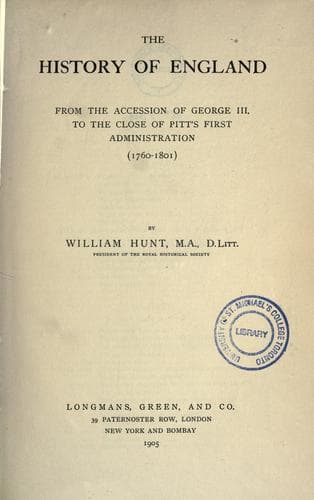
The history of England, from the accession of George III. to the close of Pitt's first administration, 1760-1801Hunt, William
History
The history of England, from the accession of George III. to the close of Pitt's first administration, 1760-1801
Hunt, William
Great Britain -- History -- George III, 1760-1820
Some good work was done in other directions; the cider-tax was repealed,
a commercial treaty was made with Russia, and the house of commons came
into agreement with the judges on the question of general warrants by
resolving that general warrants being illegal, except in the cases
provided for by act of parliament, the arrest of any of its members on
such a warrant would be a breach of privilege. The administration,
however, was enfeebled by the unconcealed dislike of the king, the
hostility of Pitt, and the general belief that it was keeping him out of
office. Pitt was extremely anxious for office, but would not accept it
unless a "transposition of offices" was made; unless, in fact,
Rockingham was got rid of. To this Rockingham would not consent; he
wanted Pitt to take office as his ally, not as his successor. There were
differences in the cabinet on the matter. The king's section wished to
gain Pitt for their master; Rockingham was upheld by his friends;
Grafton wanted Pitt as prime minister, and Conway, though less decided,
agreed with him. Pitt became querulous and unreasonable, and in April
violently attacked the ministers, specially excepting Grafton and
Conway.[74] All attempts at negotiation having failed, Grafton made his
choice for Pitt and resigned office. It was not easy to fill his place,
for the ministry was regarded as moribund, and finally the king was
forced to give the seals to Rockingham's friend, the young Duke of
Richmond. The chancellor, Northington, a strong supporter of the king,
saw that the end was not far off, and apparently determined to make sure
of a place in the next administration by sacrificing his colleagues. He
quarrelled with them in the cabinet on a question relating to the
administration of law in Canada, and early in July told the king that he
must resign office, and that the ministry was too weak to go on. George
eagerly seized the opportunity for getting rid of it and replacing it by
a more comprehensive ministry with Pitt at its head. The difficulties
which had stood in Pitt's way were removed; the American question seemed
to be settled; he had made it known that he would not again be guided by
Temple, and he was delighted to be the king's minister, avowing his
determination "to defend the closet against every contending
party"--against, that is, the great whig houses and their connexions.
Public-domain text, read in full here on John Shaqi.
Reviews
Reviews
No reviews yet
Be the first to share your thoughts on this work.
Elsewhere in the archive
Join the Discussion
Join the discussion
Sign in to leave a comment or review.
Sign InorCreate an account