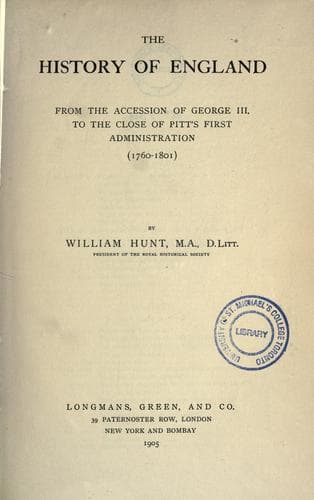
The history of England, from the accession of George III. to the close of Pitt's first administration, 1760-1801Hunt, William
History
The history of England, from the accession of George III. to the close of Pitt's first administration, 1760-1801
Hunt, William
Great Britain -- History -- George III, 1760-1820
Both in England and America the repeal of the stamp act was hailed with
rejoicing. American discontent was hushed, and the public manifestations
of gladness were accompanied by expressions of loyalty and affection for
the mother-country. The colonists, however, knew that they had won a
victory over parliament, and they did not forget it. Their substantial
grievance, the commercial regulations, still remained; they soon saw
that they must go further, and that Pitt's distinction between a direct
money-tax and duties on merchandise, though it had served their
immediate purpose, would no longer be useful. The declaratory act was
regarded as a menace, and kept alive their feelings of suspicion and
irritation. Their temper was shown by the delay of many of the colonies
to vote the required compensation. In Massachusetts, where the vote was
passed in December, it was insolently accompanied by a vote of indemnity
to all concerned in the riots. The repeal of the stamp act needs no
defence; a mistake had been made which was leading to serious
consequences, and in such a case it is a statesmanlike policy to retrace
the false step. The declaratory act was passed to save the dignity of
parliament. In spite of Burke's admiration for this act, it may be
suggested that the assertion of a right by a party which at the same
time declines to enforce it, is neither a dignified nor a wise
proceeding. Its only, and sufficient defence is that without it the
repeal of the tax would have been impossible. The Americans' denial of
the right of parliament, accompanied as it was by violence of word and
action, roused much indignation in England and involved every supporter
of the repeal in the imputation of betraying its dignity. If repeal was
to be carried it was necessary to satisfy men's minds by a declaration
of the right of parliament to tax the colonies.
[Sidenote: _THE CHATHAM MINISTRY._]
Public-domain text, read in full here on John Shaqi.
Reviews
Reviews
No reviews yet
Be the first to share your thoughts on this work.
Elsewhere in the archive
Join the Discussion
Join the discussion
Sign in to leave a comment or review.
Sign InorCreate an account