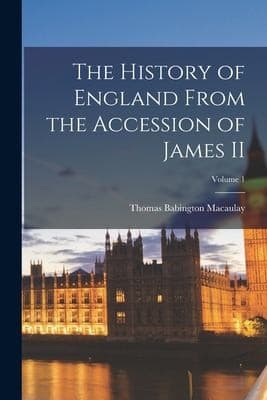
The History of England, from the Accession of James II — Volume 1 — John Shaqi
The History of England, from the Accession of James II — Volume 1Macaulay, Thomas Babington Macaulay, Baron
History
The History of England, from the Accession of James II — Volume 1
Macaulay, Thomas Babington Macaulay, Baron
Great Britain -- History -- James II, 1685-1688; Great Britain -- History -- William and Mary, 1689-1702
Even the spiritual supremacy arrogated by the Pope was, in the dark
ages, productive of far more good than evil. Its effect was to unite the
nations of Western Europe in one great commonwealth. What the Olympian
chariot course and the Pythian oracle were to all the Greek cities, from
Trebizond to Marseilles, Rome and her Bishop were to all Christians
of the Latin communion, from Calabria to the Hebrides. Thus grew up
sentiments of enlarged benevolence. Races separated from each other by
seas and mountains acknowledged a fraternal tie and a common code of
public law. Even in war, the cruelty of the conqueror was not seldom
mitigated by the recollection that he and his vanquished enemies were
all members of one great federation.
Into this federation our Saxon ancestors were now admitted. A regular
communication was opened between our shores and that part of Europe in
which the traces of ancient power and policy were yet discernible.
Many noble monuments which have since been destroyed or defaced still
retained their pristine magnificence; and travellers, to whom Livy and
Sallust were unintelligible, might gain from the Roman aqueducts and
temples some faint notion of Roman history. The dome of Agrippa, still
glittering with bronze, the mausoleum of Adrian, not yet deprived of its
columns and statues, the Flavian amphitheatre, not yet degraded into a
quarry, told to the rude English pilgrims some part of the story of that
great civilised world which had passed away. The islanders returned,
with awe deeply impressed on their half opened minds, and told the
wondering inhabitants of the hovels of London and York that, near the
grave of Saint Peter, a mighty race, now extinct, had piled up buildings
which would never be dissolved till the judgment day. Learning followed
in the train of Christianity. The poetry and eloquence of the Augustan
age was assiduously studied in Mercian and Northumbrian monasteries. The
names of Bede and Alcuin were justly celebrated throughout Europe. Such
was the state of our country when, in the ninth century, began the last
great migration of the northern barbarians.
Public-domain text, read in full here on John Shaqi.
Reviews
Reviews
No reviews yet
Be the first to share your thoughts on this work.
Join the Discussion
Join the discussion
Sign in to leave a comment or review.
Sign InorCreate an account