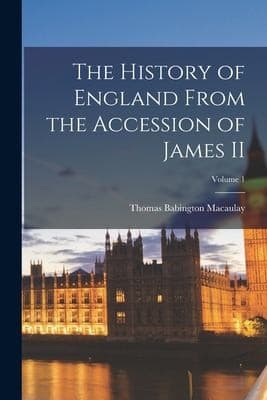
The History of England, from the Accession of James II — Volume 1 — John Shaqi
The History of England, from the Accession of James II — Volume 1Macaulay, Thomas Babington Macaulay, Baron
History
The History of England, from the Accession of James II — Volume 1
Macaulay, Thomas Babington Macaulay, Baron
Great Britain -- History -- James II, 1685-1688; Great Britain -- History -- William and Mary, 1689-1702
A successor of Becket
was foremost among the refractory magnates who obtained that charter
which secured the privileges both of the Norman barons and of the Saxon
yeomanry. How great a part the Roman Catholic ecclesiastics subsequently
had in the abolition of villenage we learn from the unexceptionable
testimony of Sir Thomas Smith, one of the ablest Protestant counsellors
of Elizabeth. When the dying slaveholder asked for the last sacraments,
his spiritual attendants regularly adjured him, as he loved his soul,
to emancipate his brethren for whom Christ had died. So successfully had
the Church used her formidable machinery that, before the Reformation
came, she had enfranchised almost all the bondmen in the kingdom
except her own, who, to do her justice, seem to have been very tenderly
treated.
There can be no doubt that, when these two great revolutions had been
effected, our forefathers were by far the best governed people in
Europe. During three hundred years the social system had been in a
constant course of improvement. Under the first Plantagenets there had
been barons able to bid defiance to the sovereign, and peasants degraded
to the level of the swine and oxen which they tended. The exorbitant
power of the baron had been gradually reduced. The condition of the
peasant had been gradually elevated. Between the aristocracy and
the working people had sprung up a middle class, agricultural and
commercial. There was still, it may be, more inequality than is
favourable to the happiness and virtue of our species: but no man was
altogether above the restraints of law; and no man was altogether below
its protection.
That the political institutions of England were, at this early period,
regarded by the English with pride and affection, and by the most
enlightened men of neighbouring nations with admiration and envy,
is proved by the clearest evidence. But touching the nature of these
institutions there has been much dishonest and acrimonious controversy.
The historical literature of England has indeed suffered grievously from
a circumstance which has not a little contributed to her prosperity. The
change, great as it is, which her polity has undergone during the
last six centuries, has been the effect of gradual development, not of
demolition and reconstruction. The present constitution of our country
is, to the constitution under which she flourished five hundred years
ago, what the tree is to the sapling, what the man is to the boy. The
alteration has been great. Yet there never was a moment at which the
chief part of what existed was not old. A polity thus formed must abound
in anomalies. But for the evils arising from mere anomalies we have
ample compensation. Other societies possess written constitutions
more symmetrical. But no other society has yet succeeded in uniting
revolution with prescription, progress with stability, the energy of
youth with the majesty of immemorial antiquity.
Public-domain text, read in full here on John Shaqi.
Reviews
Reviews
No reviews yet
Be the first to share your thoughts on this work.
Join the Discussion
Join the discussion
Sign in to leave a comment or review.
Sign InorCreate an account