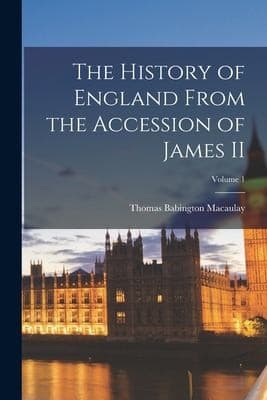
The History of England, from the Accession of James II — Volume 1Macaulay, Thomas Babington Macaulay, Baron
History
The History of England, from the Accession of James II — Volume 1
Macaulay, Thomas Babington Macaulay, Baron
Great Britain -- History -- James II, 1685-1688; Great Britain -- History -- William and Mary, 1689-1702
No English King has ever laid claim to the general legislative power.
The most violent and imperious Plantagenet never fancied himself
competent to enact, without the consent of his great council, that a
jury should consist of ten persons instead of twelve, that a widow's
dower should be a fourth part instead of a third, that perjury should
be a felony, or that the custom of gavelkind should be introduced into
Yorkshire. [2] But the King had the power of pardoning offenders; and
there is one point at which the power of pardoning and the power of
legislating seem to fade into each other, and may easily, at least in a
simple age, be confounded. A penal statute is virtually annulled if the
penalties which it imposes are regularly remitted as often as they are
incurred. The sovereign was undoubtedly competent to remit penalties
without limit. He was therefore competent to annul virtually a penal
statute. It might seem that there could be no serious objection to his
doing formally what he might do virtually. Thus, with the help of subtle
and courtly lawyers, grew up, on the doubtful frontier which separates
executive from legislative functions, that great anomaly known as the
dispensing power.
That the King could not impose taxes without the consent of Parliament
is admitted to have been, from time immemorial, a fundamental law of
England. It was among the articles which John was compelled by the
Barons to sign. Edward the First ventured to break through the rule:
but, able, powerful, and popular as he was, he encountered an opposition
to which he found it expedient to yield. He covenanted accordingly in
express terms, for himself and his heirs, that they would never again
levy any aid without the assent and goodwill of the Estates of the
realm. His powerful and victorious grandson attempted to violate this
solemn compact: but the attempt was strenuously withstood. At length the
Plantagenets gave up the point in despair: but, though they ceased to
infringe the law openly, they occasionally contrived, by evading it,
to procure an extraordinary supply for a temporary purpose. They were
interdicted from taxing; but they claimed the right of begging and
borrowing. They therefore sometimes begged in a tone not easily to be
distinguished from that of command, and sometimes borrowed with small
thought of repaying. But the fact that they thought it necessary to
disguise their exactions under the names of benevolences and loans
sufficiently proves that the authority of the great constitutional rule
was universally recognised.
Public-domain text, read in full here on John Shaqi.
Reviews
Reviews
No reviews yet
Be the first to share your thoughts on this work.
Join the Discussion
Join the discussion
Sign in to leave a comment or review.
Sign InorCreate an account