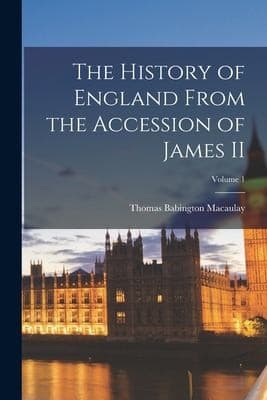
The History of England, from the Accession of James II — Volume 1Macaulay, Thomas Babington Macaulay, Baron
History
The History of England, from the Accession of James II — Volume 1
Macaulay, Thomas Babington Macaulay, Baron
Great Britain -- History -- James II, 1685-1688; Great Britain -- History -- William and Mary, 1689-1702
It was not only by the efficiency of the restraints imposed on the royal
prerogative that England was advantageously distinguished from most of
the neighbouring countries. A: peculiarity equally important, though
less noticed, was the relation in which the nobility stood here to the
commonalty. There was a strong hereditary aristocracy: but it was of all
hereditary aristocracies the least insolent and exclusive. It had none
of the invidious character of a caste. It was constantly receiving
members from the people, and constantly sending down members to mingle
with the people. Any gentleman might become a peer. The younger son of a
peer was but a gentleman. Grandsons of peers yielded precedence to newly
made knights. The dignity of knighthood was not beyond the reach of
any man who could by diligence and thrift realise a good estate, or
who could attract notice by his valour in a battle or a siege. It was
regarded as no disparagement for the daughter of a Duke, nay of a royal
Duke, to espouse a distinguished commoner. Thus, Sir John Howard married
the daughter of Thomas Mowbray Duke of Norfolk. Sir Richard Pole married
the Countess of Salisbury, daughter of George, Duke of Clarence. Good
blood was indeed held in high respect: but between good blood and the
privileges of peerage there was, most fortunately for our country, no
necessary connection. Pedigrees as long, and scutcheons as old, were to
be found out of the House of Lords as in it. There were new men who bore
the highest titles. There were untitled men well known to be descended
from knights who had broken the Saxon ranks at Hastings, and scaled the
walls of Jerusalem. There were Bohuns, Mowbrays, DeVeres, nay, kinsmen
of the House of Plantagenet, with no higher addition than that of
Esquire, and with no civil privileges beyond those enjoyed by every
farmer and shopkeeper. There was therefore here no line like that which
in some other countries divided the patrician from the plebeian. The
yeoman was not inclined to murmur at dignities to which his own children
might rise. The grandee was not inclined to insult a class into which
his own children must descend.
Public-domain text, read in full here on John Shaqi.
Reviews
Reviews
No reviews yet
Be the first to share your thoughts on this work.
Join the Discussion
Join the discussion
Sign in to leave a comment or review.
Sign InorCreate an account