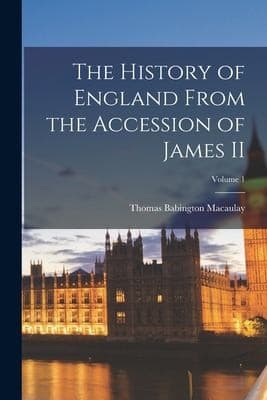
The History of England, from the Accession of James II — Volume 1Macaulay, Thomas Babington Macaulay, Baron
History
The History of England, from the Accession of James II — Volume 1
Macaulay, Thomas Babington Macaulay, Baron
Great Britain -- History -- James II, 1685-1688; Great Britain -- History -- William and Mary, 1689-1702
Henry the Eighth attempted to constitute an Anglican Church differing
from the Roman Catholic Church on the point of the supremacy, and on
that point alone. His success in this attempt was extraordinary. The
force of his character, the singularly favourable situation in which
he stood with respect to foreign powers, the immense wealth which the
spoliation of the abbeys placed at his disposal, and the support of
that class which still halted between two Opinions, enabled him to bid
defiance to both the extreme parties, to burn as heretics those who
avowed the tenets of the Reformers, and to hang as traitors those who
owned the authority of the Pope. But Henry's system died with him. Had
his life been prolonged, he would have found it difficult to maintain a
position assailed with equal fury by all who were zealous either for
the new or for the old opinions. The ministers who held the royal
prerogatives in trust for his infant son could not venture to persist in
so hazardous a policy; nor could Elizabeth venture to return to it. It
was necessary to make a choice. The government must either submit to
Rome, or must obtain the aid of the Protestants. The government and the
Protestants had only one thing in common, hatred of the Papal power.
The English Reformers were eager to go as far as their brethren on the
Continent. They unanimously condemned as Antichristian numerous dogmas
and practices to which Henry had stubbornly adhered, and which Elizabeth
reluctantly abandoned. Many felt a strong repugnance even to things
indifferent which had formed part of the polity or ritual of the
mystical Babylon. Thus Bishop Hooper, who died manfully at Gloucester
for his religion, long refused to wear the episcopal vestments. Bishop
Ridley, a martyr of still greater renown, pulled down the ancient altars
of his diocese, and ordered the Eucharist to be administered in the
middle of churches, at tables which the Papists irreverently termed
oyster boards. Bishop Jewel pronounced the clerical garb to be a stage
dress, a fool's coat, a relique of the Amorites, and promised that
he would spare no labour to extirpate such degrading absurdities.
Archbishop Grindal long hesitated about accepting a mitre from dislike
of what he regarded as the mummery of consecration. Bishop Parkhurst
uttered a fervent prayer that the Church of England would propose to
herself the Church of Zurich as the absolute pattern of a Christian
community. Bishop Ponet was of opinion that the word Bishop should be
abandoned to the Papists, and that the chief officers of the purified
church should be called Superintendents. When it is considered that
none of these prelates belonged to the extreme section of the Protestant
party, it cannot be doubted that, if the general sense of that party
had been followed, the work of reform would have been carried on as
unsparingly in England as in Scotland.
Public-domain text, read in full here on John Shaqi.
Reviews
Reviews
No reviews yet
Be the first to share your thoughts on this work.
Join the Discussion
Join the discussion
Sign in to leave a comment or review.
Sign InorCreate an account