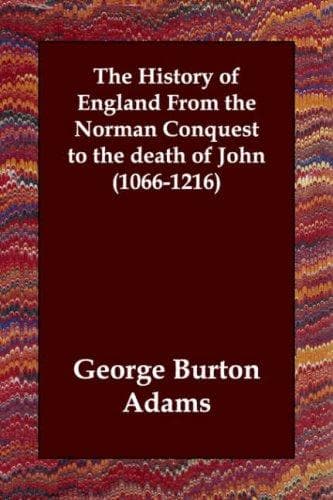
The History of England from the Norman Conquest to the Death of John (1066-1216)Adams, George Burton
History
The History of England from the Norman Conquest to the Death of John (1066-1216)
Adams, George Burton
Great Britain -- History -- Medieval period, 1066-1485
The question most easily settled was that of Henry's marriage. According
to the historians of his reign, affection led Henry to a marriage which
was certainly most directly in line with the policy which he was carrying
out. Soon after his coronation, he proposed to marry Edith, daughter of
Malcolm, king of Scotland, and of Margaret, sister of the atheling Edgar.
She had spent almost the whole of her life in English monasteries, a good
part of it at Romsey, where her aunt Christina was abbess. Immediately
the question was raised, whether she had not herself taken the veil,
which she was known to have worn, and therefore whether the marriage was
possible. This was the question now referred to Anselm, and he made a
most careful examination of the case, and decision was finally pronounced
in a council of the English Church. The testimony of the young woman
herself was admitted and was conclusive against any binding vow. She had
been forced by her aunt to wear the veil against her will as a means of
protection in those turbulent times, but she had always rejected it with
indignation when she had been able to do so, nor had it been her father's
intention that she should be a nun. Independent testimony confirmed her
assertion, and it was formally declared that she was free to marry. The
marriage took place on November 11, and was celebrated by Anselm, who
also crowned the new queen under the Norman name of Matilda, which she
assumed.
No act which Henry could perform would be more pleasing to the nation as
a whole than this marriage, or would seem to them clearer proof of his
intention to rule in the interest of the whole nation and not of himself
alone, or of the small body of foreign oppressors. It would seem like the
expression of a wish on Henry's part to unite his line with that of the
old English kings, and to reign as their representative as well as his
father's, and it was so understood, both by the party opposed to Henry
and by his own supporters. Whatever we may think of the dying prophecy
attributed to Edward the Confessor, that the troubles which he foresaw
for England should end when the green tree--the English dynasty--cut off
from its root and removed for the space of three acres' breadth--three
foreign reigns--should without human help be joined to it again and bring
forth leaves and fruit, the fact that it was thought, in Henry's reign,
to have been fulfilled by his marriage with Matilda and by the birth of
their children, shows plainly enough the general feeling regarding the
marriage and that for which it stood. The Norman sneer, in which the king
and his wife are referred to as Godric and Godgifu, is as plain an
indication of the feeling of that party. Such a taunt as this could not
have been called out by the mere marriage, and would never have been
spoken if the policy of the king, in spite of the marriage, had been one
in sympathy with the wishes of the extreme Norman element.
Public-domain text, read in full here on John Shaqi.
Reviews
Reviews
No reviews yet
Be the first to share your thoughts on this work.
Elsewhere in the archive
Join the Discussion
Join the discussion
Sign in to leave a comment or review.
Sign InorCreate an account