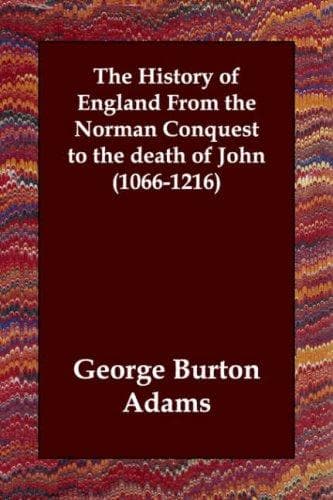
The History of England from the Norman Conquest to the Death of John (1066-1216)Adams, George Burton
History
The History of England from the Norman Conquest to the Death of John (1066-1216)
Adams, George Burton
Great Britain -- History -- Medieval period, 1066-1485
This was a new position for Anselm to take; it was also raising a new
question in the government of England. For more than a quarter of a
century the papacy had been fighting this battle against lay investiture
with all the weapons at its disposal, against its nearest rival, the
emperor, and with less of open conflict and more of immediate success in
most of the other lands of Europe. But in the dominions of the Norman
princes the question had never become a living issue. This was not
because the papacy had failed to demand the authority there which it was
striving to secure elsewhere. Gregory VII had laid claim to an even more
complete authority over England than this. But these demands had met with
no success. Even as regards the more subordinate features of the
Hildebrandine reformation, simony and the celibacy of the clergy, the
response of the Norman and English churches to the demand for
reformation had been incomplete and half-hearted, and not even the
beginning of a papal party had shown itself in either country. This
exceptional position is to be accounted for by the great strength of the
crown, and also by the fact that the sovereign in his dealings with the
Church was following in both states the policy marked out by a long
tradition. Something must also be attributed, and probably in Normandy as
well as in England, to the clearness with which Lanfranc perceived the
double position of the bishop in the feudal state. The Church was an
important part of the machinery of government, and as such its officers
were appointed by the king, and held accountable to him for a large part
at least of their official action. This was the theory of the Norman
state, and this theory had been up to this time unquestioned. It is
hardly too much to call the Norman and English churches, from the
coronation of William I on to this time, practically independent national
churches, with some relationship to the pope, but with one so external in
its character that no serious inconvenience would have been experienced
in their own government had some sudden catastrophe swept the papacy out
of existence.
Public-domain text, read in full here on John Shaqi.
Reviews
Reviews
No reviews yet
Be the first to share your thoughts on this work.
Elsewhere in the archive
Join the Discussion
Join the discussion
Sign in to leave a comment or review.
Sign InorCreate an account