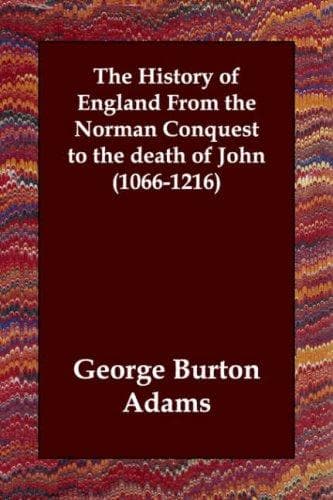
The History of England from the Norman Conquest to the Death of John (1066-1216)Adams, George Burton
History
The History of England from the Norman Conquest to the Death of John (1066-1216)
Adams, George Burton
Great Britain -- History -- Medieval period, 1066-1485
It was, however, in truth impossible for England to keep itself free from
the issue which had been raised by the war upon lay investiture. The real
question involved in this controversy was one far deeper than the
question of the appointment of bishops by the sovereign of the state.
That was a point of detail, a means to the end; very important and
essential as a means, but not the end itself. Slowly through centuries of
time the Church had become conscious of itself. Accumulated precedents of
the successful exercise of power, observation of the might of
organization, and equally instructive experience of the weakness of
disorganization and of the danger of self-seeking, personal or political,
in the head of the Christian world, had brought the thinking party in the
Church to understand the dominant position which it might hold in the
world if it could be controlled as a single organization and animated by
a single purpose. It was the vision of the imperial Church, free from all
distracting influence of family or of state, closely bound together into
one organic whole, an independent, world-embracing power: more than this
even, a power above all other powers, the representative of God, on
earth, to which all temporal sovereigns should be held accountable.
That the Church failed to gain the whole of that for which it strove was
not the fault of its leaders. A large part of the history of the world in
the eleventh and twelfth centuries is filled with the struggle to create,
in ideal completeness, this imperial Church. The reformation of Cluny had
this for its ultimate object. From the beginning made by that movement,
the political genius of Hildebrand sketched the finished structure and
pointed out the means to be employed in its completion. That the emperor
was first and most fiercely attacked was not due to the fact that he was
a sinner above all others in the matter of lay investiture or simony. It
was the most urgent necessity of the case that the papacy should make
itself independent of that power which in the past had exercised the most
direct sovereignty over the popes, and before the conflict should end be
able to take its seat beside the empire as an equal, or even a superior,
world power. But if the empire must be first overcome, no state could be
left out of this plan, and in England as elsewhere the issue must sooner
or later be joined.
Public-domain text, read in full here on John Shaqi.
Reviews
Reviews
No reviews yet
Be the first to share your thoughts on this work.
Elsewhere in the archive
Join the Discussion
Join the discussion
Sign in to leave a comment or review.
Sign InorCreate an account