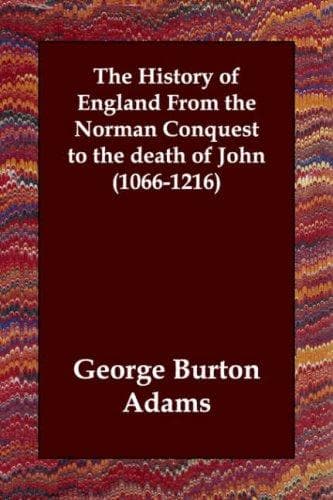
The History of England from the Norman Conquest to the Death of John (1066-1216)Adams, George Burton
History
The History of England from the Norman Conquest to the Death of John (1066-1216)
Adams, George Burton
Great Britain -- History -- Medieval period, 1066-1485
At Whitsuntide and again in August the restlessness of Hugh Bigod in East
Anglia had forced Stephen to march against him. Perhaps he felt that he
had not received a large enough reward for the doubtful oath which he had
sworn to secure the king his crown. Stephen at any rate was now in a
situation where he could not withhold rewards, or even refuse demands in
critical cases; and it was probably at this time, certainly not long
after, that, following the policy he had now definitely adopted, he
created Hugh Earl of Norfolk. A still more important and typical case,
which probably occurred in the same year, is that of Geoffrey de
Mandeville. Grandson of a baron of the Conquest, he was in succession to
his father, constable of the Tower in London, and so held a position of
great strategic importance in turbulent times. Early in the strife for
the crown he seems to have seen very clearly the opportunity for
self-aggrandizement which was offered by the uncertainty of Stephen's
power, and to have resolved to make the most of it for his own gain
without scruple of conscience. His demand was for the earldom of Essex,
and this was granted him by the king. Apparently about the same time
occurred a third case of the sort which completes the evidence that the
weakness of Stephen's character was generally recognized, and that in the
resulting attitude of many of the greater barons we have the key to his
reign. One of the virtually independent feudal principalities created in
England by the Conqueror and surviving to this time was the palatine
earldom of Chester. The then earl was Ralph II, in succession to his
father Ralph Meschin, who had succeeded on the death of Earl Richard in
the sinking of the White Ship. It had been a grievance of the first
Ralph that he had been obliged by King Henry to give up his lordship of
Carlisle on taking the earldom, and this grievance had been made more
bitter for the second Ralph when the lordship had been transferred to the
Scots. There was trouble also about the inheritance of his mother Lucy,
in Lincolnshire, in which another son of hers, Ralph's half-brother,
William of Roumare, was interested. We infer that toward the end of the
year 1140 their attitude seemed threatening to the king, for he seems to
have visited them and purchased their adherence with large gifts,
granting to William the earldom of Lincoln.
Public-domain text, read in full here on John Shaqi.
Reviews
Reviews
No reviews yet
Be the first to share your thoughts on this work.
Elsewhere in the archive
Join the Discussion
Join the discussion
Sign in to leave a comment or review.
Sign InorCreate an account