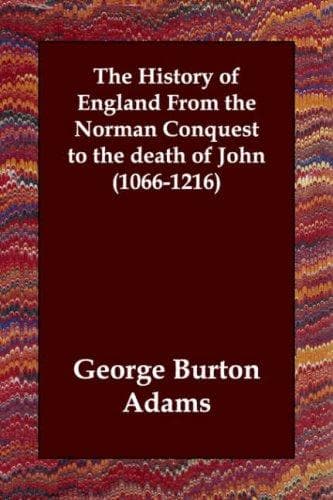
The History of England from the Norman Conquest to the Death of John (1066-1216)Adams, George Burton
History
The History of England from the Norman Conquest to the Death of John (1066-1216)
Adams, George Burton
Great Britain -- History -- Medieval period, 1066-1485
Then follows rapidly the series of events which led to the crisis of the
war. The brothers evidently were not yet satisfied. Stephen had retained
in his hands the castle of Lincoln and this Ralph and William seized by a
stratagem. Stephen, informed of what had happened by a messenger from the
citizens, acted with his characteristic energy at the beginning of any
enterprise, broke up his Christmas court at London, and suddenly, to the
great surprise of the earls, appeared in Lincoln with a besieging army.
Ralph managed to escape to raise in Chester a relieving army, and at once
took a step which becomes from this time not infrequent among the barons
of his stamp. He applied for help to Robert of Gloucester, whose
son-in-law he was, and offered to go over to Matilda with all that he
held. He was received, of course, with a warm welcome. Robert recognized
the opportunity which the circumstances probably offered to strike a
decisive blow, and, gathering the strongest force he could, he advanced
from Gloucester against the king. On the way he was joined by the Earl of
Chester, whose forces included many Welsh ready to fight in an English
quarrel but badly armed. The attacking army skirted Lincoln and appeared
on the high road leading to it from the north, where was the best
prospect of forcing an entrance to the city.
The approach of the enemy led, as usual in Stephen's armies, to divided
counsels. Some were in favour of retreating and collecting a larger army,
others of fighting at once. To fight at once would be Stephen's natural
inclination, and he determined to risk a battle, which he must have known
would have decisive consequences. His army he drew up in three bodies
across the way of approach. Six earls were with the king, reckoning the
Count of Meulan, but they had not brought strong forces and there were
few horsemen. Five of these earls formed the first line. The second was
under William of Ypres and William of Aumale, and was probably made up
of the king's foreign troops. Stephen himself, with a strong band of
men all on foot, was posted in the rear. The enemy's formation was
similar. The Earl of Chester claimed the right to lead the attack,
because the quarrel was his, but the men upon whom Robert most depended
were the "disinherited," of whom he had collected many,--men raised up
by Matilda's father and cast down by Stephen, and now ready to stake all
on the hope of revenge and of restoration; and these he placed in the
first line. Earl Ralph led the second, and himself the third. The battle
was soon over, except the struggle round the king. His first and second
lines were quickly swept away by the determined charge of Robert's men
and took to flight, but Stephen and his men beat off several attacks
before he was finally overpowered and forced to yield. He surrendered
to Robert of Gloucester. Many minor barons were taken prisoners with
him, but the six earls all escaped. The citizens of Lincoln were punished
Public-domain text, read in full here on John Shaqi.
Reviews
Reviews
No reviews yet
Be the first to share your thoughts on this work.
Elsewhere in the archive
Join the Discussion
Join the discussion
Sign in to leave a comment or review.
Sign InorCreate an account