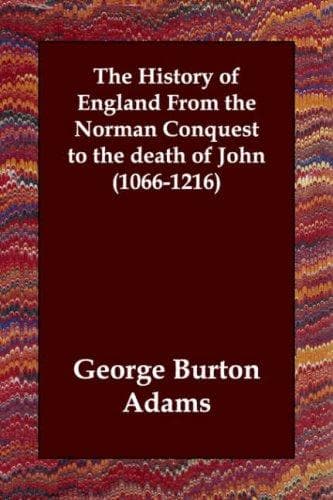
The History of England from the Norman Conquest to the Death of John (1066-1216)Adams, George Burton
History
The History of England from the Norman Conquest to the Death of John (1066-1216)
Adams, George Burton
Great Britain -- History -- Medieval period, 1066-1485
The political feudal organization was as intimately bound up with the
possession of land as the economic, but its primary object was different.
It may be described as that form of organization in which the duties of
the citizen to the state had been changed into a species of land rent. A
set of legal arrangements and personal relationships which had grown up
wholly in the field of private affairs, for the serving of private ends,
had usurped the place of public law in the state. Duties of the citizen
and functions of the government were translated into its terms and
performed as incidents of a private obligation. The individual no longer
served in the army because this service was a part of his obligation as a
citizen, but because he had agreed by private contract to do so as a part
of the rent he was to pay for the land he held of another man. The
judicial organization was transformed in the same way. The national
courts disappeared, and their place was taken by private courts made up
of tenants. The king summoned at intervals the great men of Church and
State to gather round him in his council, law court, and legislature, in
so far as there was a legislature in that age, the curia regis, the
mother institution of a numerous progeny; but he did not summon them, and
they came no longer, because they were the great men of Church and State,
the wise men of the land, but because they had entered into a private
obligation with him to attend when called upon, as a return for lands
which he had given them; or, in other words, as Henry II told the bishops
in the Constitutions of Clarendon, because they were his vassals. Public
taxation underwent the same change, and the money revenue of the feudal
state which corresponds most nearly to the income of taxation, was made
up of irregular payments due on the occurrence of specified events from
those who held land of the king, and these in turn collected like
payments of their tenants; the relief, for instance, on the succession of
the heir to his father's holding, or the aids in three cases, on the
knighting of the lord's eldest son, the marrying of his eldest daughter,
and the ransom of his own person from imprisonment. The contact of the
central government with the mass of the men of the state was broken off
by the intervening series of lords who were political rulers each of the
territory or group of lands immediately subject to himself, and exercised
within those limits the functions which the general government should
normally exercise for the whole state. The payments and services which
the lord's vassals made to him, while they were of the nature of rent,
were not rent in the economic sense; they were important to the suzerain
less as matters of income than as defining his political power and
marking his rank in this hierarchical organization. The state as a whole
might retain its geographical outlines and the form of a common
government, but it was really broken up into fragments of varying size,
Public-domain text, read in full here on John Shaqi.
Reviews
Reviews
No reviews yet
Be the first to share your thoughts on this work.
Join the Discussion
Join the discussion
Sign in to leave a comment or review.
Sign InorCreate an account