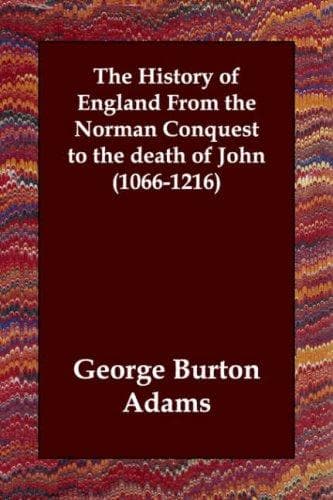
The History of England from the Norman Conquest to the Death of John (1066-1216)Adams, George Burton
History
The History of England from the Norman Conquest to the Death of John (1066-1216)
Adams, George Burton
Great Britain -- History -- Medieval period, 1066-1485
At the date of the Norman Conquest of England, this tendency was more
nearly realized in France than anywhere else. Within the limits of that
state a number of great feudal principalities had been formed, duchies
and counties, round the administrative divisions of an earlier time as
their starting-point, in many of which the sovereign of the state could
exercise no powers of government. The extensive powers which the earlier
system had intrusted to the duke or count as an administrative officer of
the state he now exercised as a practically independent sovereign, and
the state could expect from this portion of its territory only the feudal
services of its ruler, perhaps ill-defined and difficult to enforce. In
some cases, however, this process of breaking up the state into smaller
units went no further. Normandy, with which we are particularly
concerned, was an instance of this fact. The duke was practically the
sole sovereign of that province. The king of France was entirely shut
out. Even the Church was under the unlimited control of the duke. And
with respect to his subjects his power was as great as with respect to
his nominal sovereign. Very few great baronies existed in Normandy formed
of contiguous territory and capable of development into independent
principalities, and those that did exist were kept constantly in the
hands of relatives of the ducal house and under strong control. Political
feudalism existed in Normandy in even greater perfection and in a more
logical completeness, if we regard the forms alone, its practices and
customs, than was usual in the feudal world of that age; but it existed
not as the means by which the state was broken into fragments, but as the
machinery by which it was governed by the duke. It formed the bond of
connexion between him and the great men of the state. It defined the
services which he had the right to demand of them, and which they in turn
might demand of their vassals. It formed the foundation of the army and
of the judicial system. Every department of the state was influenced by
its forms and principles. At the same time the Duke of Normandy was more
than a feudal suzerain. He had saved on the whole, from the feudal
deluge, more of the prerogatives of sovereignty than had the king of
France. He had a considerable non-feudal administrative system, though it
might not reach all parts of the duchy. The supreme judicial power had
never been parted with, and the Norman barons were unable to exercise in
its full extent the right of high justice. The oath of allegiance from
all freemen, whosesoever vassals they might be, traces of which are to be
found in many feudal lands and even under the Capetian kings, was
retained in the duchy. Private war, baronial coinage, engagements with
foreign princes to the injury of the duke,--these might occur in
exceptional cases during a minority or under a weak duke, or in time of
rebellion; but the strong dukes repressed them with an iron hand, and no
Public-domain text, read in full here on John Shaqi.
Reviews
Reviews
No reviews yet
Be the first to share your thoughts on this work.
Join the Discussion
Join the discussion
Sign in to leave a comment or review.
Sign InorCreate an account