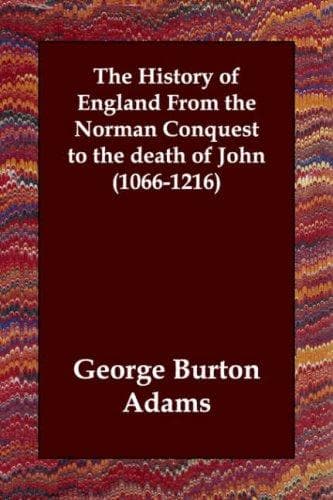
The History of England from the Norman Conquest to the Death of John (1066-1216)Adams, George Burton
History
The History of England from the Norman Conquest to the Death of John (1066-1216)
Adams, George Burton
Great Britain -- History -- Medieval period, 1066-1485
Having settled the matters which demanded immediate attention, the king
proceeded to make a progress through those parts of his kingdom which
were under his control. Just where he went we are not told, but he can
hardly have gone far outside the counties of southern and eastern England
which were directly influenced by his march on London. In such a progress
he probably had chiefly in mind to take possession for himself and his
men of confiscated estates and of strategic points. No opposition showed
itself anywhere, but women with their children appeared along the way to
beseech his mercy, and the favour which he showed to these suppliants was
thought worthy of special remark. Winchester seems to have been visited,
and secured by the beginning of a Norman castle within the walls, and the
journey ended at Pevensey, where he had landed so short a time before in
pursuit of the crown. William had decided that he could return to
Normandy, and the decision that this could be safely done with so small a
part of the kingdom actually in hand, with so few castles already built
or garrisons established, is the clearest possible evidence of William's
opinion of the situation. He would have been the last man to venture such
a step if he had believed the risk to be great. And the event justified
his judgment. The insurrectionary movements which called him back clearly
appear to have been, not so much efforts of the nation to throw off a
foreign yoke, as revolts excited by the oppression and bad government of
those whom he had left in charge of the kingdom.
On the eve of his departure he confided the care of his new kingdom to
two of his followers whom he believed the most devoted to himself, the
south-east to his half brother Odo, and the north to William Fitz Osbern.
Odo, Bishop of Bayeux, but less an ecclesiastic, according to the ideals
of the Church, than a typically feudal bishop, was assigned the
responsibility for the fortress of Dover, was given large estates in Kent
and to the west of it, and was probably made earl of that county at this
time. William Fitz Osbern was the son of the duke's guardian, who had
been murdered for his fidelity during William's minority, and they had
been boys together, as we are expressly told. He was appointed to be
responsible for Winchester and to hold what might be called the marches,
towards the unoccupied north and west. Very probably at this time also he
was made Earl of Hereford? Some other of the leading nobles of the
Conquest had been established in their possessions by this date, as we
know on good evidence, like Hugh of Grantmesnil in Hampshire, but the
chief dependence of the king was apparently upon these two, who are
spoken of as having under their care the minor holders of the castles
which had been already established.
Public-domain text, read in full here on John Shaqi.
Reviews
Reviews
No reviews yet
Be the first to share your thoughts on this work.
Join the Discussion
Join the discussion
Sign in to leave a comment or review.
Sign InorCreate an account