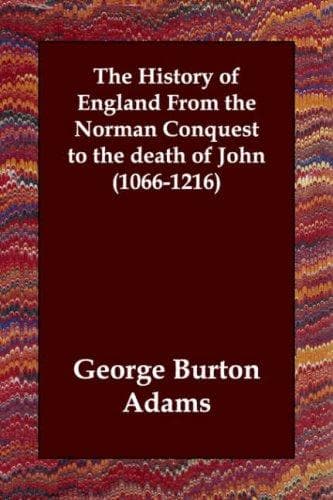
The History of England from the Norman Conquest to the Death of John (1066-1216) — John Shaqi
The History of England from the Norman Conquest to the Death of John (1066-1216)Adams, George Burton
History
The History of England from the Norman Conquest to the Death of John (1066-1216)
Adams, George Burton
Great Britain -- History -- Medieval period, 1066-1485
In the meantime, affairs had not run smoothly in England. We may easily
guess that William's lieutenants, especially his brother, had not failed
on the side of too great gentleness in carrying out his directions to
secure the land with garrisons and castles. In various places unconnected
with one another troubles had broken out. In the north, where Copsi had
been made Earl of Northumberland, an old local dynastic feud was still
unsettled, and the mere appointment of an earl would not bring it to an
end. Copsi was slain by his rival, Oswulf, who was himself soon afterward
killed, but the Norman occupation had still to be begun. In the west a
more interesting resistance to the Norman advance had developed near
Hereford, led by Edric, called the Wild, descendant of a noble Saxon
house. He had enlisted the support of the Welsh, and in retaliation for
attacks upon himself had laid waste a large district in Herefordshire.
Odo had had in his county an insurrection which threatened for a moment
to have most serious consequences, but which had ended in a complete
failure. The men of Kent, planning rebellion, had sent across the channel
to Eustace, Count of Boulogne, who believed that he had causes of
grievance against William, and had besought him to come to their aid in
an attempt to seize the fortress of Dover. Eustace accepted the
invitation and crossed over at the appointed time, but his allies had not
all gathered when he arrived, and the unsteady character of the count
wrecked the enterprise. He attacked in haste, and when he failed to carry
the castle by storm, he retired in equal haste and abandoned the
undertaking. William judged him too important a man to treat with
severity, and restored him to his favour. Besides these signs which
revealed the danger of an open outbreak, William undoubtedly knew that
many of the English had left the country and had gone in various
directions, seeking foreign aid. His absence could not be prolonged
without serious consequences, and in December, 1067, he returned to
England.
[1] William of Poitiers, in Migne's Patrologia Latina, cxlix,
1258, and see F. Baring, in Engl. Hist. Rev., xiii. 18 (1898).
[2] Orderic Vitalis, ii. 158 (ed. Le Prevost).
[3] Round, Feudal England, p. 292.
CHAPTER II
THE SUBJUGATION OF LAND AND CHURCH
Public-domain text, read in full here on John Shaqi.
Reviews
Reviews
No reviews yet
Be the first to share your thoughts on this work.
Join the Discussion
Join the discussion
Sign in to leave a comment or review.
Sign InorCreate an account