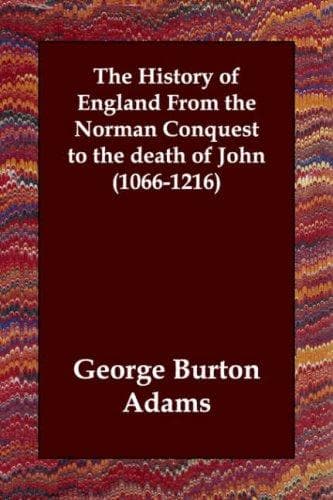
The History of England from the Norman Conquest to the Death of John (1066-1216)Adams, George Burton
History
The History of England from the Norman Conquest to the Death of John (1066-1216)
Adams, George Burton
Great Britain -- History -- Medieval period, 1066-1485
In truth, however, the year which was coming on, 1069, was another year
of crisis in the history of the Conquest. The danger which had been
threatening William from the beginning was this year to descend upon him,
and to prove as unreal as all those he had faced since the great battle
with Harold. For a long time efforts had been making to induce some
foreign power to interfere in England and support the cause of the
English against the invader. Two states seemed especially fitted for the
mission, from close relationship with England in the past,--Scotland and
Denmark. Fugitives, who preferred exile to submission, had early sought
the one or the other of these courts, and urged intervention upon their
kings. Scotland had for the moment formally accepted the Conquest.
Denmark had not done so, and Denmark was the more directly interested in
the result, not perhaps as a mere question of the independence of
England, but for other possible reasons. If England was to be ruled by a
foreign king, should not that king on historical grounds be a Dane rather
than a Norman? Ought he not to be of the land that had already furnished
kings to England? And if Sweyn dreamed of the possibility of extending
his rule, at such a time, over this other member of the empire of his
uncle, Canute the Great, he is certainly not to be blamed.
It is true that the best moment for such an intervention had been allowed
to slip by, the time when no beginning of conquest had been made in the
north, but the situation was not even yet unfavourable. William was to
learn, when the new year had hardly begun, that he really held no more of
the north than his garrisons commanded. Perhaps it was a rash attempt to
try to establish a Norman earl of Northumberland in Durham before the
land had been overawed by his own presence; but the post was important,
the two experiments which had been made to secure the country through the
appointment of English earls had failed, and the submission of the
previous summer might prove to be real. In January Robert of Comines was
made earl, and with rash confidence, against the advice of the bishop, he
took possession of Durham with five hundred men or more. He expected, no
doubt, to be very soon behind the walls of a new castle, but he was
allowed no time. The very night of his arrival the enemy gathered and
massacred him and all his men but two. Yorkshire took courage at this and
cut up a Norman detachment. Then the exiles in Scotland believed the time
had come for another attempt, and Edgar, Gospatric, and the others, with
the men of Northumberland at their back, advanced to attack the castle in
York. This put all the work of the previous summer in danger, and at the
call of William Malet, who held the castle for him, the king advanced
rapidly to his aid, fell unexpectedly on the insurgents, and scattered
them with great slaughter. As a result the Norman hold on York was
tightened by the building of a second castle, but Northumberland was
Public-domain text, read in full here on John Shaqi.
Reviews
Reviews
No reviews yet
Be the first to share your thoughts on this work.
Join the Discussion
Join the discussion
Sign in to leave a comment or review.
Sign InorCreate an account