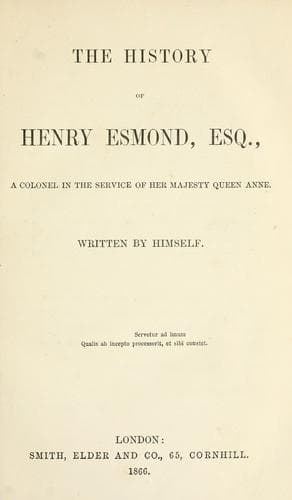
The History of Henry Esmond, Esq., a Colonel in the Service of Her Majesty Queen AnneThackeray, William Makepeace
History
The History of Henry Esmond, Esq., a Colonel in the Service of Her Majesty Queen Anne
Thackeray, William Makepeace
Great Britain -- History -- Anne, 1702-1714 -- Fiction; Historical fiction
Her heart melted, I suppose (indeed she hath since owned as much), at
the notion that she should do anything unkind to any mortal, great or
small; for, when she returned, she had sent away the housekeeper upon an
errand by the door at the farther end of the gallery; and, coming back
to the lad, with a look of infinite pity and tenderness in her eyes, she
took his hand again, placing her other fair hand on his head, and saying
some words to him, which were so kind, and said in a voice so sweet,
that the boy, who had never looked upon so much beauty before, felt as
if the touch of a superior being or angel smote him down to the ground,
and kissed the fair protecting hand as he knelt on one knee. To the very
last hour of his life, Esmond remembered the lady as she then spoke and
looked, the rings on her fair hands, the very scent of her robe, the
beam of her eyes lighting up with surprise and kindness, her lips
blooming in a smile, the sun making a golden halo round her hair.
As the boy was yet in this attitude of humility, enters behind him a
portly gentleman, with a little girl of four years old in his hand. The
gentleman burst into a great laugh at the lady and her adorer, with
his little queer figure, his sallow face, and long black hair. The lady
blushed, and seemed to deprecate his ridicule by a look of appeal to her
husband, for it was my Lord Viscount who now arrived, and whom the lad
knew, having once before seen him in the late lord's lifetime.
“So this is the little priest” says my lord, looking down at the lad;
“welcome, kinsman.”
“He is saying his prayers to mamma,” says the little girl, who came up
to her papa's knees; and my lord burst out into another great laugh at
this, and kinsman Henry looked very silly. He invented a half-dozen of
speeches in reply, but 'twas months afterwards when he thought of this
adventure: as it was, he had never a word in answer.
“Le pauvre enfant, il n'a que nous,” says the lady, looking to her lord;
and the boy, who understood her, though doubtless she thought otherwise,
thanked her with all his heart for her kind speech.
“And he shan't want for friends here,” says my lord in a kind voice,
“shall he, little Trix?”
Public-domain text, read in full here on John Shaqi.
Reviews
Reviews
No reviews yet
Be the first to share your thoughts on this work.
Join the Discussion
Join the discussion
Sign in to leave a comment or review.
Sign InorCreate an account