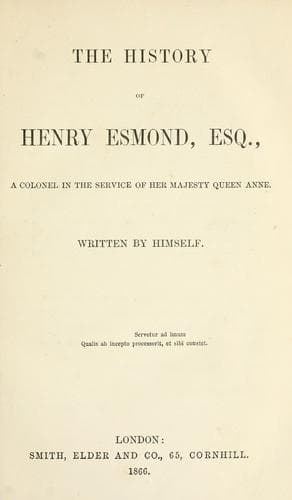
The History of Henry Esmond, Esq., a Colonel in the Service of Her Majesty Queen AnneThackeray, William Makepeace
History
The History of Henry Esmond, Esq., a Colonel in the Service of Her Majesty Queen Anne
Thackeray, William Makepeace
Great Britain -- History -- Anne, 1702-1714 -- Fiction; Historical fiction
My Lord Mohun (of whose exploits and fame some of the gentlemen of the
University had brought down but ugly reports) was once more a guest at
Castlewood, and seemingly more intimately allied with my lord even than
before. Once in the spring those two noblemen had ridden to Cambridge
from Newmarket, whither they had gone for the horse-racing, and had
honored Harry Esmond with a visit at his rooms; after which Doctor
Montague, the master of the College, who had treated Harry somewhat
haughtily, seeing his familiarity with these great folks, and that my
Lord Castlewood laughed and walked with his hand on Harry's shoulder,
relented to Mr. Esmond, and condescended to be very civil to him; and
some days after his arrival, Harry, laughing, told this story to Lady
Esmond, remarking how strange it was that men famous for learning and
renowned over Europe, should, nevertheless, so bow down to a title, and
cringe to a nobleman ever so poor. At this Mistress Beatrix flung up her
head, and said it became those of low origin to respect their betters;
that the parsons made themselves a great deal too proud, she thought;
and that she liked the way at Lady Sark's best, where the chaplain,
though he loved pudding, as all parsons do, always went away before the
custard.
“And when I am a parson,” says Mr. Esmond, “will you give me no custard,
Beatrix?”
“You--you are different,” Beatrix answered. “You are of our blood.”
“My father was a parson, as you call him,” said my lady.
“But mine is a peer of Ireland,” says Mistress Beatrix, tossing her
head. “Let people know their places. I suppose you will have me go down
on my knees and ask a blessing of Mr. Thomas Tusher, that has just been
made a curate and whose mother was a waiting-maid.”
And she tossed out of the room, being in one of her flighty humors then.
When she was gone, my lady looked so sad and grave, that Harry asked
the cause of her disquietude. She said it was not merely what he said
of Newmarket, but what she had remarked, with great anxiety and
terror, that my lord, ever since his acquaintance with the Lord
Mohun especially, had recurred to his fondness for play, which he had
renounced since his marriage.
“But men promise more than they are able to perform in marriage,” said
my lady, with a sigh. “I fear he has lost large sums; and our property,
always small, is dwindling away under this reckless dissipation. I heard
of him in London with very wild company. Since his return, letters
and lawyers are constantly coming and going: he seems to me to have a
constant anxiety, though he hides it under boisterousness and laughter.
I looked through--through the door last night, and--and before,” said
my lady, “and saw them at cards after midnight; no estate will bear that
extravagance, much less ours, which will be so diminished that my son
will have nothing at all, and my poor Beatrix no portion!”
Public-domain text, read in full here on John Shaqi.
Reviews
Reviews
No reviews yet
Be the first to share your thoughts on this work.
Elsewhere in the archive
Join the Discussion
Join the discussion
Sign in to leave a comment or review.
Sign InorCreate an account