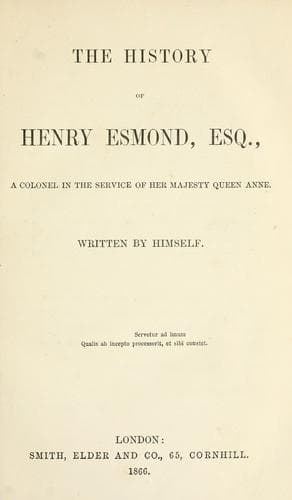
The History of Henry Esmond, Esq., a Colonel in the Service of Her Majesty Queen AnneThackeray, William Makepeace
History
The History of Henry Esmond, Esq., a Colonel in the Service of Her Majesty Queen Anne
Thackeray, William Makepeace
Great Britain -- History -- Anne, 1702-1714 -- Fiction; Historical fiction
“I wish I could help you, madam,” said Harry Esmond, sighing, and
wishing that unavailingly, and for the thousandth time in his life.
“Who can? Only God,” said Lady Esmond--“only God, in whose hands we
are.” And so it is, and for his rule over his family, and for
his conduct to wife and children--subjects over whom his power is
monarchical--any one who watches the world must think with trembling
sometimes of the account which many a man will have to render. For in
our society there's no law to control the King of the Fireside. He is
master of property, happiness--life almost. He is free to punish,
to make happy or unhappy--to ruin or to torture. He may kill a wife
gradually, and be no more questioned than the Grand seignior who drowns
a slave at midnight. He may make slaves and hypocrites of his children;
or friends and freemen; or drive them into revolt and enmity against the
natural law of love. I have heard politicians and coffee-house wiseacres
talking over the newspaper, and railing at the tyranny of the French
King, and the Emperor, and wondered how these (who are monarchs, too,
in their way) govern their own dominions at home, where each man rules
absolute. When the annals of each little reign are shown to the Supreme
Master, under whom we hold sovereignty, histories will be laid bare of
household tyrants as cruel as Amurath, and as savage as Nero, and as
reckless and dissolute as Charles.
If Harry Esmond's patron erred, 'twas in the latter way, from a
disposition rather self-indulgent than cruel; and he might have been
brought back to much better feelings, had time been given to him to
bring his repentance to a lasting reform.
As my lord and his friend Lord Mohun were such close companions,
Mistress Beatrix chose to be jealous of the latter; and the two
gentlemen often entertained each other by laughing, in their rude
boisterous way, at the child's freaks of anger and show of dislike.
“When thou art old enough, thou shalt marry Lord Mohun,” Beatrix's
father would say: on which the girl would pout and say, “I would rather
marry Tom Tusher.” And because the Lord Mohun always showed an extreme
gallantry to my Lady Castlewood, whom he professed to admire devotedly,
one day, in answer to this old joke of her father's, Beatrix said, “I
think my lord would rather marry mamma than marry me; and is waiting
till you die to ask her.”
Public-domain text, read in full here on John Shaqi.
Reviews
Reviews
No reviews yet
Be the first to share your thoughts on this work.
Elsewhere in the archive
Join the Discussion
Join the discussion
Sign in to leave a comment or review.
Sign InorCreate an account