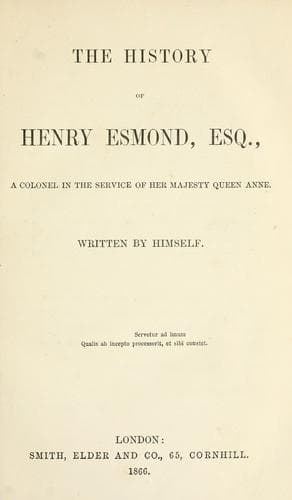
The History of Henry Esmond, Esq., a Colonel in the Service of Her Majesty Queen AnneThackeray, William Makepeace
History
The History of Henry Esmond, Esq., a Colonel in the Service of Her Majesty Queen Anne
Thackeray, William Makepeace
Great Britain -- History -- Anne, 1702-1714 -- Fiction; Historical fiction
My Lord Viscount was put to bed, and his wound looked to by the surgeon,
who seemed both kind and skilful. When he had looked to my lord, he
bandaged up Harry Esmond's hand (who, from loss of blood, had fainted
too, in the house, and may have been some time unconscious); and when
the young man came to himself, you may be sure he eagerly asked what
news there were of his dear patron; on which the surgeon carried him
to the room where the Lord Castlewood lay; who had already sent for a
priest; and desired earnestly, they said, to speak with his kinsman. He
was lying on a bed, very pale and ghastly, with that fixed, fatal look
in his eyes, which betokens death; and faintly beckoning all the other
persons away from him with his hand, and crying out “Only Harry Esmond,”
the hand fell powerless down on the coverlet, as Harry came forward, and
knelt down and kissed it.
“Thou art all but a priest, Harry,” my Lord Viscount gasped out, with a
faint smile, and pressure of his cold hand. “Are they all gone? Let me
make thee a death-bed confession.”
And with sacred Death waiting, as it were, at the bed-foot, as an awful
witness of his words, the poor dying soul gasped out his last wishes
in respect of his family;--his humble profession of contrition for his
faults;--and his charity towards the world he was leaving. Some things
he said concerned Harry Esmond as much as they astonished him. And
my Lord Viscount, sinking visibly, was in the midst of these strange
confessions, when the ecclesiastic for whom my lord had sent, Mr.
Atterbury, arrived.
This gentleman had reached to no great church dignity as yet, but
was only preacher at St. Bride's, drawing all the town thither by his
eloquent sermons. He was godson to my lord, who had been pupil to his
father; had paid a visit to Castlewood from Oxford more than once; and
it was by his advice, I think, that Harry Esmond was sent to Cambridge,
rather than to Oxford, of which place Mr. Atterbury, though a
distinguished member, spoke but ill.
Our messenger found the good priest already at his books at five o'clock
in the morning, and he followed the man eagerly to the house where my
poor Lord Viscount lay--Esmond watching him, and taking his dying words
from his mouth.
My lord, hearing of Mr. Atterbury's arrival, and squeezing Esmond's
hand, asked to be alone with the priest; and Esmond left them there for
this solemn interview. You may be sure that his own prayers and grief
accompanied that dying benefactor. My lord had said to him that which
confounded the young man--informed him of a secret which greatly
concerned him. Indeed, after hearing it, he had had good cause for doubt
and dismay; for mental anguish as well as resolution. While the colloquy
between Mr. Atterbury and his dying penitent took place within, an
immense contest of perplexity was agitating Lord Castlewood's young
companion.
Public-domain text, read in full here on John Shaqi.
Reviews
Reviews
No reviews yet
Be the first to share your thoughts on this work.
Elsewhere in the archive
Join the Discussion
Join the discussion
Sign in to leave a comment or review.
Sign InorCreate an account