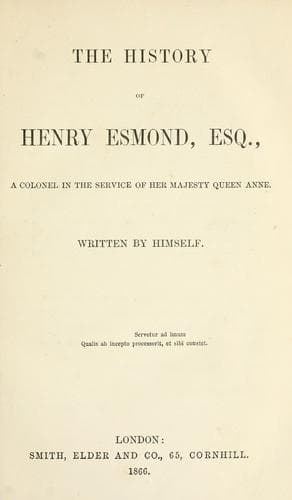
The History of Henry Esmond, Esq., a Colonel in the Service of Her Majesty Queen AnneThackeray, William Makepeace
History
The History of Henry Esmond, Esq., a Colonel in the Service of Her Majesty Queen Anne
Thackeray, William Makepeace
Great Britain -- History -- Anne, 1702-1714 -- Fiction; Historical fiction
At the end of an hour--it may be more--Mr. Atterbury came out of the
room, looking very hard at Esmond, and holding a paper.
“He is on the brink of God's awful judgment,” the priest whispered. “He
has made his breast clean to me. He forgives and believes, and makes
restitution. Shall it be in public? Shall we call a witness to sign it?”
“God knows,” sobbed out the young man, “my dearest lord has only done me
kindness all his life.”
The priest put the paper into Esmond's hand. He looked at it. It swam
before his eyes.
“'Tis a confession,” he said.
“'Tis as you please,” said Mr. Atterbury.
There was a fire in the room where the cloths were drying for the baths,
and there lay a heap in a corner saturated with the blood of my dear
lord's body. Esmond went to the fire, and threw the paper into it. 'Twas
a great chimney with glazed Dutch tiles. How we remember such trifles at
such awful moments!--the scrap of the book that we have read in a great
grief--the taste of that last dish that we have eaten before a duel, or
some such supreme meeting or parting. On the Dutch tiles at the Bagnio
was a rude picture representing Jacob in hairy gloves, cheating Isaac of
Esau's birthright. The burning paper lighted it up.
“'Tis only a confession, Mr. Atterbury,” said the young man. He leaned
his head against the mantel-piece: a burst of tears came to his eyes.
They were the first he had shed as he sat by his lord, scared by this
calamity, and more yet by what the poor dying gentleman had told him,
and shocked to think that he should be the agent of bringing this double
misfortune on those he loved best.
“Let us go to him,” said Mr. Esmond. And accordingly they went into the
next chamber, where by this time, the dawn had broke, which showed my
lord's poor pale face and wild appealing eyes, that wore that awful
fatal look of coming dissolution. The surgeon was with him. He went into
the chamber as Atterbury came out thence. My Lord Viscount turned round
his sick eyes towards Esmond. It choked the other to hear that rattle in
his throat.
“My Lord Viscount,” says Mr. Atterbury, “Mr. Esmond wants no witnesses,
and hath burned the paper.”
“My dearest master!” Esmond said, kneeling down, and taking his hand and
kissing it.
My Lord Viscount sprang up in his bed, and flung his arms round Esmond.
“God bl--bless--” was all he said. The blood rushed from his mouth,
deluging the young man. My dearest lord was no more. He was gone with a
blessing on his lips, and love and repentance and kindness in his manly
heart.
“Benedicti benedicentes,” says Mr. Atterbury, and the young man,
kneeling at the bedside, groaned out an “Amen.”
Public-domain text, read in full here on John Shaqi.
Reviews
Reviews
No reviews yet
Be the first to share your thoughts on this work.
Elsewhere in the archive
Join the Discussion
Join the discussion
Sign in to leave a comment or review.
Sign InorCreate an account